Modern Manual Therapy Blog - Manual Therapy, Videos, Neurodynamics, Podcasts, Research Reviews: thoracic spine
Showing posts with label thoracic spine. Show all posts
Untold Physio Stories - Hyper-Focused on Pain - themanualtherapist.com


In this episode Andrew and Erson discuss a patient who is very focused on her pain. Her evaluation is not straight forward and nothing really stands out for her point tender right lower rib pain. What are your thoughts?


Untold Physio Stories is sponsored by


Helix Pain Creams - I use Helix Creams in my practice and patients love them! Perfect in combination with joint mobs, IASTM and soft tissue work. Use code MMT2 to get your sample and get an additional revenue stream for your practice. Click here to get started.


Check out EDGE Mobility System's Best Sellers - Something for every PT, OT, DC, MT, ATC or Fitness Minded Individual


My PT Insurance - Insurance just got easier. check out the self employed and employed plans. Easy sign up and coverage that follows you wherever you practice in the United States. Save $20 if you sign up using our link.


Keeping it Eclectic...

Untold Physio Stories - Dry Needling Adverse Event? - themanualtherapist.com


At a recent seminar, a PT told a case of a possible dry needling adverse event. After consultation with a specialist, scans, and better history from the patient, it seems more like a spontaneous or patient caused injury rather than iatrogenic. What do you think? Have you ever heard of anything similar? 


Untold Physio Stories is sponsored by


Helix Pain Creams - I use Helix Creams in my practice and patients love them! Perfect in combination with joint mobs, IASTM and soft tissue work. Use code MMT2 to get your sample and get an additional revenue stream for your practice. Click here to get started.


Check out EDGE Mobility System's Best Sellers - Something for every PT, OT, DC, MT, ATC or Fitness Minded Individual


My PT Insurance - Insurance just got easier. check out the self employed and employed plans. Easy sign up and coverage that follows you wherever you practice in the United States. Save $20 if you sign up using our link.


Keeping it Eclectic...

Untold Physio Stories - Rotated Pelvis Placebo or Nocebo? - themanualtherapist.com


The modern clinician generally hates hearing "I've been told my pelvis is rotated" or "my vertebrae are out of place." It's often time consuming and can be difficult to educate maladaptive beliefs, but it's worth it if you want better outcomes and to reduce fear avoidance behaviors. What happens to a chronic pain patient who is told by another clinician that her pelvis is rotated? Listen in and find out!


Erson and Andrew are featured in the amazing new compilation text, Movers and Mentors! Click our link to get your copy from amazon! It's full of amazing quotes, useful information from many instructors, researchers, and great clinicians of our profession.


Untold Physio Stories is sponsored by


EDGE Health and Tech Solutions - we level up your website with full SEO optimization, turn it into a referral generating machine and do full Google Workspace and Telehealth integrations


Modern Manual Therapy Insiders - over 650 Exclusive videos, Research Reviews, Webinars, Online Discussion - learn easy to apply Clinical Practice Patterns, integrate Pain Science with Manual Therapy and Patient Education - Join now!


Also, be sure to check out EDGE Mobility System's Best Sellers - Something for every PT, OT, DC, MT, ATC or Fitness Minded Individual

Keeping it Eclectic...

Upper Limb Rotation Test: Validity and Reliability


ℹ️ℹ️
INTRO:
Several risk factors exist for throwing-related shoulder injuries, such as:

  • Glenohumeral Internal Rotation Deficit (GIRD).
  • Reduced total range of motion.
  • Scapular dyskinesia.
  • External/internal rotation strength ratio imbalances.

ℹ️
Physical performance tests (PPTs) provide a a functional status of the athlete’s upper extremity.
ℹ️
These PPTs are routinely used for:

  • Injury prediction.
  • Performance enhancement.
  • Post-rehabilitation outcome measures.

ℹ️
Some PPTs have been developed for closed kinetic chain (CKC), such as:
Closed Kinetic Chain Upper Extremity Stability Test (CKCUEST). -
and -
Open kinetic chain (OKC), such as:
Seated medicine ball throw (SMBT).
ℹ️
Many PPTs currently used do not fully address specific requirements of overhead throwing, including:
A combination of OKC, CKC and a trunk rotation as well as 90°/90° shoulder position .
ℹ️
To comply with this need, the Upper Limb Rotation Test (ULRT), may be better, as it includes:

  • Weight bearing.
  • Shoulder motor control and stability.
  • Involves the entire kinetic chain.
  • Places the shoulder in 90°/90° position.

ℹ️
Decleve et al. (2020) test 91 healthy adults to determine the reliability of the ULRT and examined the correlations with two widely used PPTs:
CKCUEST
SMBT
-
and .
-
2 clinical measurements:
Shoulder isometric rotational strength.
Trunk rotational range of motion (SRT).
✅✅
MAIN FINDINGS:
High relative reliability values and clinically acceptable absolute reliability values were found.
✅
The ULRT showed moderate correlations with the CKCUEST and SMBT.
✅
The ULRT is a good physical performance test of:

  • OKC
  • CKC
  • Trunk rotation
  • 90°/90° shoulder position.

📊📊
CONCLUSIONS:

  • Very high intra-session reliability.
  • High reliability for test-retest.
  • Clinically acceptable absolute reliability.

📊
Moderately correlated with:
CKCUEST and SMBT.
📊
Poorly correlated with:
Shoulder isometric rotational strength and SRT. .
🧠🧠
Thoughts? Questions? Comments?
🧠
Write them below. .
📚📚📚
SOURCE:
Decleve et al. 2020. The “upper limb rotation test”: Reliability and validity. There in Sport.
#physicaltherapyresearch


Dalton Urrutia, MSc PT

Dalton is a Physical Therapist from Oregon, currently living and running the performance physiotherapy clinic he founded in London for Grapplers and Strength & Conditioning athletes. Dalton runs the popular instagram account @physicaltherapyresearch, where he posts easy summaries of current and relevant research on health, fitness, and rehab topics. 
Want to learn more or contact him?
Reach out online:
@Grapplersperformance
www.grapplersperformance.com


Want to learn in person? Attend a #manualtherapyparty! Check out our course calendar below!

Learn more online - new online discussion group included!


Want an approach that enhances your existing evaluation and treatment? No commercial model gives you THE answer. You need an approach that blends the modern with the old school. 
  • NEW - Online Discussion Group
  • Live cases
  • webinars
  • lecture
  • Live Q&A
  • over 600 videos - hundreds of techniques and more! 
  • Check out MMT Insiders
Keeping it Eclectic...


Many thoracic, shoulder, cervical and some lumbar cases require breathing assessment and rib treatment.

Recently I listed to a fantastic podcast by Jo Gibson through Clinical Edge on Thoracic Outlet Syndrome and was thrilled to learn some advances which have taken place in our knowledge of this condition since I first published a blog on the topic in 2013. Seven years later and I am excited to share a revised piece that includes the latest ideas around clinical assessment, and in particular sensory testing in the differential diagnosis of this challenging condition.
Thoracic outlet syndrome (TOS) is a syndrome/condition that encompasses a cluster of upper extremity symptoms which are due to compression of the neurovascular bundle by various structures in the area just above the first rib and behind the clavicle. The three most common regions where compressions is thought to occur is the intrascalene triangle, the costoclavicular triangle and the subcoracoid space.
Thoracic outlet syndrome was first described in 1927 by Adson and colleagues and known at this time as scalenus anticus syndrome. The formal term that most authors refers to as Thoracic outlet syndrome was derived by Peet and colleagues in 1956.

CLASSIFICATION OF THORACIC OUTLET SYNDROME

In the current research trials, thoracic outlet syndrome is being classified into the following categories: 
  1. The first category is Vascular TOS, which includes arterial and venous and accounts for ~ 5% of all presentations.
  2. The second category is Neurological TOS, which is broken down further into true and symptomatic TOS.
  3. Symptomatic TOS comprises over 80% of all people presenting with this diagnosis. That is to say there is a huge proportion of patients will present with no radiological or electrophysical abnormality (Hooper et al., 2010a; Sanders et al., 2007; Kaczynski et al., 2013).
Thoracic outlet syndrome remains a diagnosis of exclusion and recent studies have revealed that it can take up to 60 months (5 years) for patients with symptomatic TOS to gain an appropriate diagnosis. This statistic shocked me. It is known that TOS is a cluster of neurological, pain and vascular deficits that sit on a continuum from intermittent to permanent impairments. It is also know that presentation of these symptoms vary from patient to patient. Often it is difficult to say specifically where the point of compression is and radiological and electrophysical testing can present as normal. So what exactly can we look for in our clinical assessment to assist with diagnosis?

DIAGNOSIS & CLINICAL PRESENTATION

The diagnosis of thoracic outlet syndrome remains disputed as there is no standard objective test to confirm clinical impressions. It remains a diagnosis of exclusion (Hooper, et al., 2010, p. 76). 
“Diagnosis of symptomatic thoracic outlet syndrome is dependent on a systematic, comprehensive upper-body examination” (Watson et al, 2009, p.588). 
Watson and colleagues provide a two-part masterclass which comprehensively outlines the musculoskeletal examination required to arrive at the diagnosis of TOS, and provide treatment strategies to manage scapular dyskinesia, muscular imbalances and improve container dysfunction. It was one of the best sources I came across in this body of research and applicable to every day clinical practice. For further reading on clinical presentation, diagnosis and management I would refer you to these two articles. 
  • Watson, L. A., Pizzari, T., & Balster, S. (2009). Thoracic outlet syndrome part 1: Clinical manifestations, differentiation and treatment pathways. Manual   therapy, 14(6), 586-595.
  • Watson, L. A., Pizzari, T., & Balster, S. (2010). Thoracic outlet syndrome Part 2: Conservative management of thoracic outlet. Manual therapy, 15(4), 305-314.

DIFFERENTIAL DIAGNOSIS

In 2016, Illig et al published an article discussing the reporting standards of vascular surgeons for the diagnosis of neurogenic TOS. These standards state that 3 of the 4 following should be present.
  1. Signs and symptoms of pathology at the thoracic outlet (scalene triangle or pectoral insertion)
  2. Signs and symptoms of nerve compression which worsens with overhead movement
  3. Absence of other pathology
  4. Positive response to scalene muscle test injection
Interestingly, these same authors state that EMG is not required and Brachial plexus imaging is not required to make an accurate diagnosis of nTOS (Illig et al., 2016, p.e30).
In my first blog, there is further detail on the comprehensive upper-body examination, clinical presentation and differential diagnosis. What I have learnt through the podcast is that we can add to this examination a useful questionnaire and newly developed clinical quantitative sensory testing for small nerve fibre conduction.

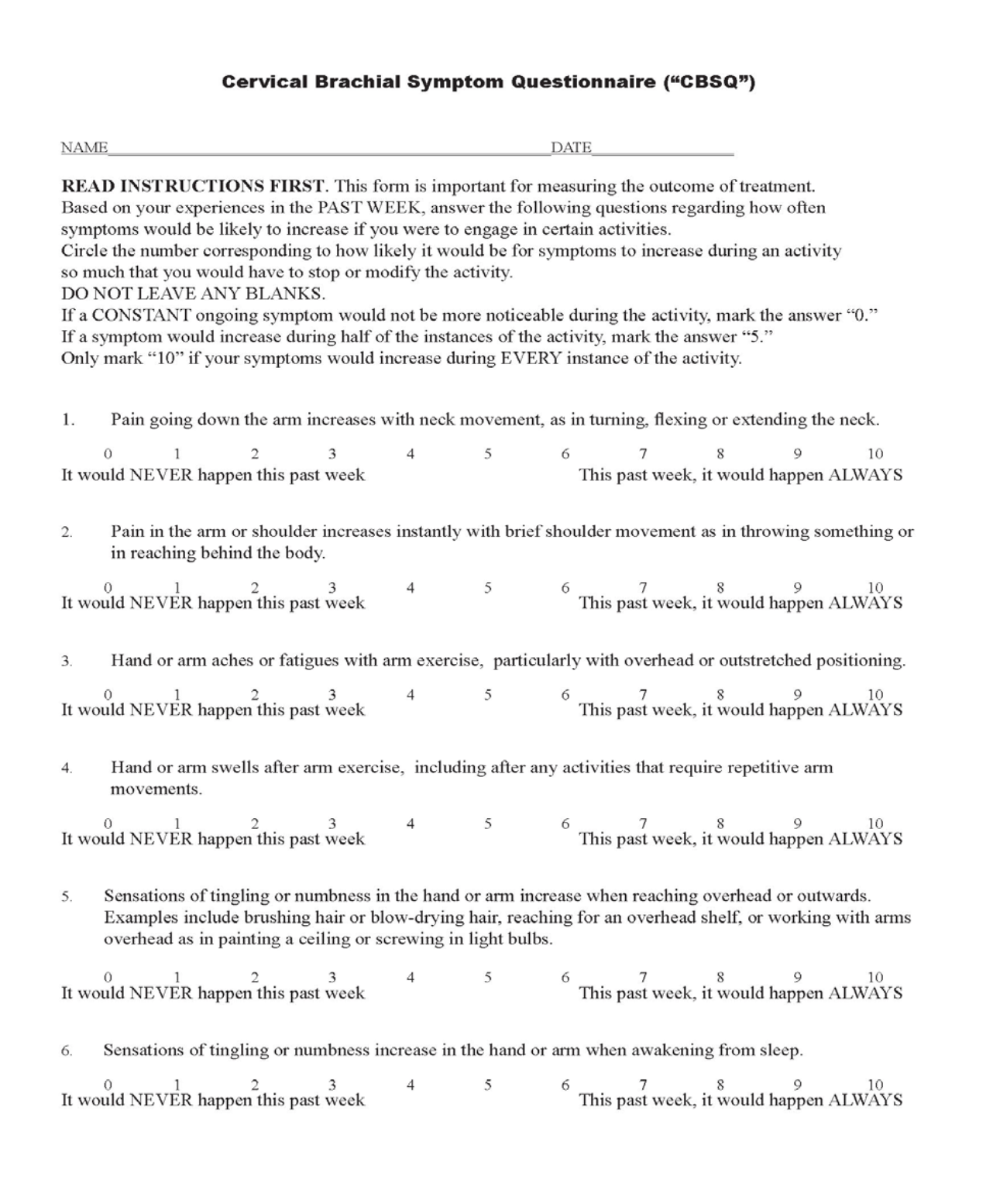
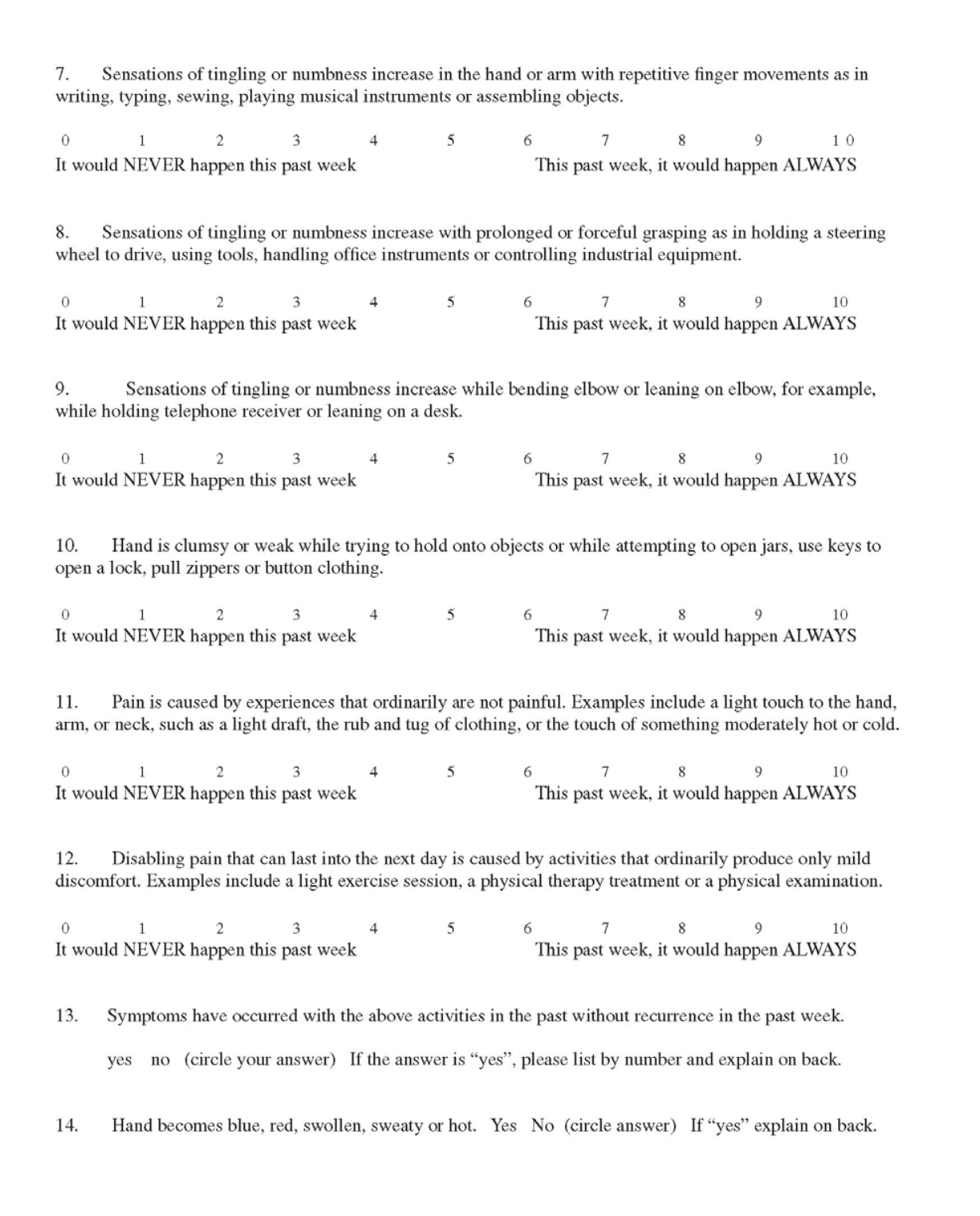
CERVICOBRACHIAL SYMPTOM QUESTIONNAIRE (CBSQ)

It is hypothesized that patients with TOS should not demonstrate an overabundance of symptoms throughout the arm, neck and shoulder region characterized as widespread pain. Instead, they should demonstrate patterns of sensory disturbance and motor weakness localized to the lower trunk of the brachial plexus. The CSBQ was developed to help differentiate patients with localized versus widespread pain to assist with differential diagnosis. Content validity of the questions within this questionnaire was determined collectively by two vascular surgeons and three neurosurgeons. This questionnaire was developed and validated in 2007 by Jordan, Ahn and Gelabert.

SMALL FIBRE SENSORY TESTING

Previously I thought of neurological testing as part of the “ruling out” process when trying to identify patients with cervical radiculopathy and other conditions. After listening to the podcast and reading this paper by Ridehalgh et al (2018), I can now see that it is important to examine both the large diameter and small diameter nerve fibres.
Ridehalgh, Sandy-Hindmarch & Schmid (2018) developed a testing procedure which involves combining warm/cold and mechanical pain threshold assessment to identify small fibre degeneration (SFD). Their results showed that:
  • Normal warm (WDT) or cold (CDT) sensation is highly sensitive (0.98) to rule out SFD, but has low specificity.
  • Reduction in pinprick is high specific (0.88) to rule in SFD.
Warm/cold detection
  • First the examiner used a coin at room temperature (cold testing) and assessed the lateral upper arm and palmar side of the index finger asking the patient to rate the temperature as same, colder or warmer. If the answer was “warmer at the finger” this would indicate a deficit in cold detection.
  • The the examiner would repeat the procedure with a coin that had been in their pocket for 30 minutes (warm testing).
  • No change in rating of cold/warm testing was interpreted as an indication that no small fibre degeneration was present.
Mechanical pain threshold
  • The examiner could use either a neurotip or toothpick.
  • The median nerve was tested by comparing detection of a “sharp” sensation at the ventral forearm and palmar tip of the index finger. Again the patient was asked to rate the sensation as same, sharper, less sharp.
  • The radial nerve was tested using the lateral upper arm and the palmar aspect of the index finger.
As you can see, both of these simple bedside tests for small fibre conduction can be easy to incorporate in your overall examination of a patient with potential TOS. I am eager to also try the CBSQ with suspected patients to assist with my overall clinical reasoning and differential diagnosis. I want to thank Jo Gibson and David Pope for sharing such valuable information on their blog and helping to guide me in the right direction with my assessment and management of these patients in the future.
Sian Smale is an Australian-trained Musculoskeletal Physiotherapist. Sian completed her Bachelor of Physiotherapy through La Trobe University in 2009 and in 2013 was awarded a Masters in Musculoskeletal Physiotherapy through Melbourne University. Since graduating from her Masters program, Sian has been working in a Private Practice setting and writing a Physiotherapy Blog "Rayner & Smale". Prior to moving to San Francisco, Sian worked at Physical Spinal and Physiotherapy Clinic and has a strong background in manual therapy and management of spinal spine, headaches and sports injuries. Since moving to the Bay area, Sian has become a Physiotherapist for the Olympic Winter Institute of Australia, traveling with their Para Alpine teams. Sian currently works full time at TherapydiaSF as a physical therapist and clinical pilates instructor. 
instagram @siansmale_SF
References:
Hooper, T. L., Denton, J., McGalliard, M. K., Brismée, J.-M., & Sizer Jr, P. S. (2010). Thoracic outlet syndrome: a controversial clinical condition. Part 1: anatomy, and clinical examination/diagnosis. The Journal of manual & manipulative therapy, 18(2), 74.
Hooper, T. L., Denton, J., McGalliard, M. K., Brismee, J. M., & Sizer, P. S., Jr. (2010). Thoracic outlet syndrome: a controversial clinical condition. Part 2: non-surgical and surgical management. The Journal of manual & manipulative therapy, 18(3), 132-138.
Illig, K. A., Donahue, D., Duncan, A., Freischlag, J., Gelabert, H., Johansen, K., ... & Thompson, R. (2016). Reporting standards of the Society for Vascular Surgery for thoracic outlet syndrome. Journal of vascular surgery, 64(3), e23-e35.
Kaczynski, J., & Fligelstone, L. (2013). Surgical and Functional Outcomes After Thoracic Outlet Syndrome Decompression via Supraclavicular Approach: A 10-Year Single Centre Experience. Journal of Current Surgery, 3(1), 7-12.
Peet, R. M., Henriksen, J. D., Anderson, T., & Martin, G. M. (1956). Thoracic-outlet syndrome: evaluation of a therapeutic exercise program. Paper presented at the   Proceedings of the staff meetings. Mayo Clinic.
Ridehalgh, C., Sandy-Hindmarch, O. P., & Schmid, A. B. (2018). Validity of clinical small–fiber sensory testing to detect small–nerve fiber degeneration. journal of orthopaedic & sports physical therapy, 48(10), 767-774.
Sanders, R. J. (2013). Anatomy of the Thoracic Outlet and Related Structures Thoracic Outlet Syndrome (pp. 17-24): Springer.
Sanders, R. J., Hammond, S. L., & Rao, N. M. (2007). Diagnosis of thoracic outlet syndrome. Journal of vascular surgery, 46(3), 601-604.
Watson, L. A., Pizzari, T., & Balster, S. (2009). Thoracic outlet syndrome part 1: Clinical manifestations, differentiation and treatment pathways. Manual therapy, 14(6), 586-595.
Watson, L. A., Pizzari, T., & Balster, S. (2010). Thoracic outlet syndrome Part 2: Conservative management of thoracic outlet. Manual therapy, 15(4), 305-314.
Want to learn in person? Attend a #manualtherapyparty! Check out our course calendar below!

Learn more online!


Want an approach that enhances your existing evaluation and treatment? No commercial model gives you THE answer. You need an approach that blends the modern with the old school. Live cases, webinars, lectures, Q&A, hundreds of techniques and more! Check out Modern Manual Therapy!

Keeping it Eclectic...