Modern Manual Therapy Blog - Manual Therapy, Videos, Neurodynamics, Podcasts, Research Reviews: Modern Nutritional Rehab
Showing posts with label Modern Nutritional Rehab. Show all posts
[RESEARCH] Collagen Supplementation for Joint Pain and Arthritis: Does it Really Work? - themanualtherapist.com


Collagen Supplementation for Joint Pain and Arthritis: Does it Really Work?

By Dr. Sean M.Wells, DPT, PT, OCS, ATC/L, CSCS, NSCA-CPT, CNPT, Cert-DN

Recently I was presenting at the annual conference of Athletic Trainers' Association of Florida (ATAF) and I was overwhelmed by one consistent question: why didn't you talk about collagen supplementation? My talk was specifically on orthopedics for older adults and naturally I focused on osteoarthritis (OA) and how important exercise and diet are for that condition. I did touch on some supplementation, but I left off collagen because my last examination of this supplement, using one of my favorite websites Examine.com, yielded mediocre results. However the participants at the sports medicine conference piqued my interest and convinced me that perhaps I had missed something -- almost every single one of these participants had some form of joint pain or stiffness and felt significantly better after taking collagen daily. So, back to the literature, and asking some of my clients, I went!

What is Collagen?

Collagen is a protein found in the body that provides structure and support to various tissues, including joints, bones, tendons, and ligaments. It may play a role in maintaining joint health and may have potential benefits for individuals with joint pain. A few small-scale studies have shown positive results in reducing joint pain and improving joint function when individuals with osteoarthritis took collagen supplements. These studies often used specific collagen formulations, such as collagen peptides or hydrolyzed collagen, which are broken down into smaller peptides for better absorption by the body. However, it's important to note that the findings of these studies are not yet conclusive, and more robust research is necessary.

The Research

It's worth mentioning that joint pain can have various causes, and collagen supplementation may not be effective for everyone. Factors like age, underlying health conditions, overall diet, and lifestyle habits can also influence joint health. For instance, a meta-analysis on collagen supplementation for OA showed improvements in the WOMAC, a functional score for knee arthritis, but it didn't yield significant results for knee pain. Meanwhile, another review article looking at collagen supplementation for joint pain, muscle protein synthesis, and body composition found that collagen did significantly reduce joint pain (it had effect on the other metrics). Here's a nice table listed in the article:
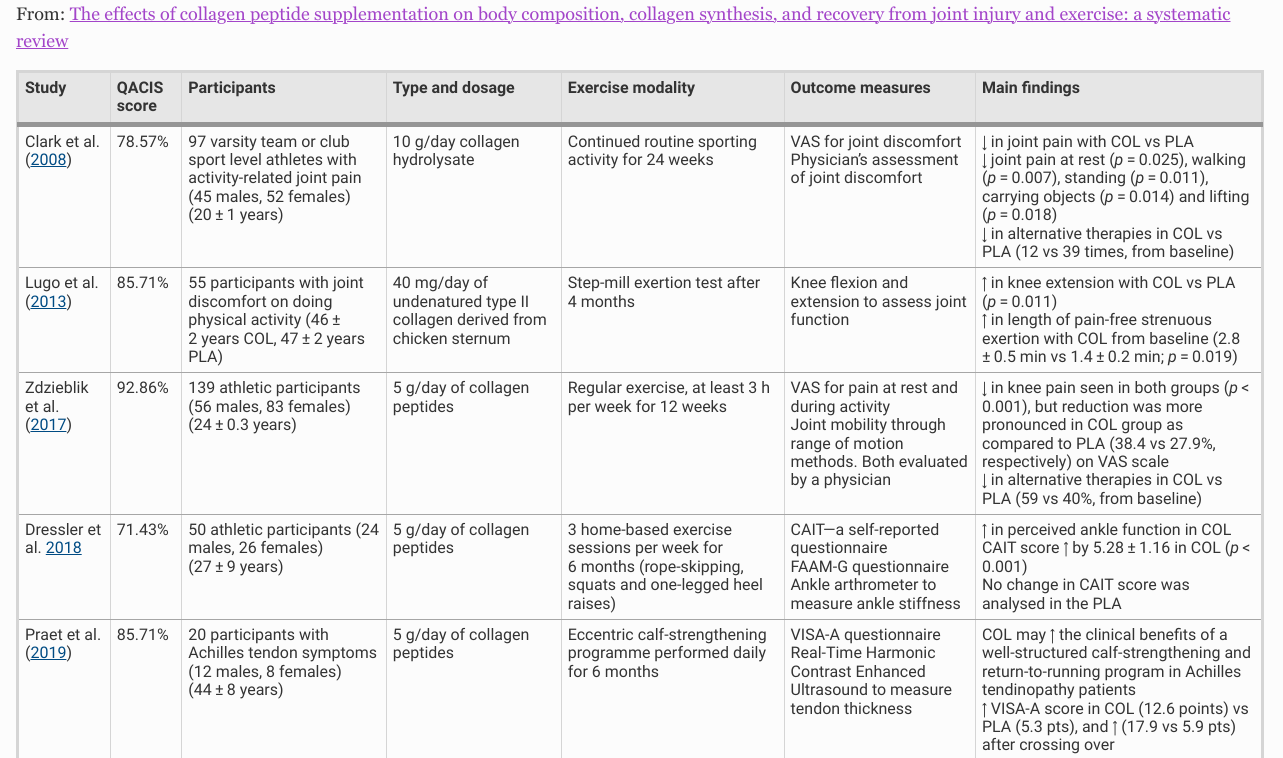
The joint pain included in the review included knee pain and Achilles tendinopathy, all predominately in an athletic population. Another glaring observation is several of these studies included physical therapy and exercise prescriptions with the supplementation (Yay! Nutrition and Physical Therapy), which can also alter the results and effects of collagen as well. It's important to see the doses varied in the studies from 5, 10, to 40 grams per day; moreover, the collagen can come in varying form from peptides, hydrolyzed proteins, to denatured collagen.  Having such variability in the type of collagen also likely explains the variability in responses and data.

Dosing

So, roughly how much and what type of collagen should a client take? Well, many studies have used dosages ranging from 8 to 12 grams of collagen peptides or hydrolyzed collagen per day for joint-related benefits. Research suggests that type II collagen supplementation may help reduce joint pain and improve joint function in individuals with arthritis, particularly osteoarthritis. It is believed to work by helping to restore and support cartilage health, potentially reducing inflammation and promoting joint mobility. It's important to note that collagen supplements are available in various forms, such as powders, capsules, and liquids, and their concentration of collagen can vary. Therefore, it's crucial to follow the manufacturer's instructions and consult with a healthcare professional to determine the appropriate dosage for your specific needs.

It's also worth mentioning that collagen supplements are often combined with other ingredients, such as vitamins, minerals, or herbal extracts, which may influence their effectiveness. If you decide to try collagen supplementation for joint pain, it's a good idea to choose a reputable brand and look for products that have been tested for quality and safety. I suggest using Labdoor.com to help you or your client find a high-quality collagen supplement, if and when appropriate.

Summary

In the end, perhaps the participants at the ATAF conference were right -- there is something to say about collagen and joint pain. Not every study is exact and more research needs to be done on what dose, what age, what condition, and what exercises should be done with the collagen -- but that's why we  practice physical therapy! Love to hear your thoughts and maybe some of your clients' responses to collagen. 



If you like what you see here then know there is more in our 3 board-approved continuing education courses on Nutrition specific for Physical Therapists. Enroll today in our new bundled course offering and save 20%, a value of $60! Earn CEUs in most states for PTs!


Want to learn in person? Attend a #manualtherapyparty! Check out our course calendar below!

Learn more online - new online discussion group included!


Want an approach that enhances your existing evaluation and treatment? No commercial model gives you THE answer. You need an approach that blends the modern with the old school. 
  • NEW - Online Discussion Group
  • Live cases
  • webinars
  • lecture
  • Live Q&A
  • over 600 videos - hundreds of techniques and more! 
  • Check out MMT Insiders
Keeping it Eclectic...

Preventing Muscle Mass Loss - themanualtherapist.com


By Dr. Sean Wells, DPT, PT, OCS, ATC/L, CSCS, NSCA-CPT, CNPT, Cert-DN

As physical therapists (PTs) we do our best to optimize our older clients' strength, balance, and functioning. Obviously, our mainstay interventions focus on exercises, balance training, and adaptive equipment. In our courses, we highlight the importance of Vitamin D status and protein consumption for older adults, to improve balance, strength, and prevent sarcopenia. A recent study in Nature Aging highlights yet another potential dietary component that impacts muscle function: ceramides.

Ceramides, a sphingolipid, which is a type of fat, has been shown to reduce muscle mass and functional capacity in rodents. Moreover, it has been shown that offering ceramide-inhibiting medication effectively reverses sarcopenia, which is very promising for human studies. In the current study the authors examined older adults with a genetic variant to inhibit ceramides. The results showed these adults with the variant had significantly better grip strength, walking distance, and sit to stand function: all metrics that Doctors of Physical Therapy (DPT) routinely measure. The next big step for these researchers is understanding how to yield these results via medication and/or dietary changes.

Fortunately, other authors have highlighted how PTs and other clinicians can advise their patients on how to naturally reduce ceramides in their diet. In the FRUVEDomic pilot study, authors demonstrated that a diet low in fruits and vegetables, and high in saturated fat, facilitated an increase in hepatic ceramide production. The researchers concluded that even transitioning patients from a standard Western diet to even the US Dietary Guidelines would yield positive responses for aging. Imagine the impact on aging and physical functioning if we took the diet to a bit more extreme, such as the true Mediterranean or predominant plant-based diet? More research is needed, but PTs need to be aware that fruit and vegetable consumption is important for many health outcomes, and screening tools are available and easy to use. We discuss this and more in our courses!

If you like what you see here then know there is more in our 3 board-approved continuing education courses on Nutrition specific for Physical Therapists. Enroll today in our new bundled course offering and save 20%, a value of $60!


Want to learn in person? Attend a #manualtherapyparty! Check out our course calendar below!

Learn more online - new online discussion group included!


Want an approach that enhances your existing evaluation and treatment? No commercial model gives you THE answer. You need an approach that blends the modern with the old school. 
  • NEW - Online Discussion Group
  • Live cases
  • webinars
  • lecture
  • Live Q&A
  • over 600 videos - hundreds of techniques and more! 
  • Check out MMT Insiders
Keeping it Eclectic...

Exercise Affects the Gut Microbiome - theManualTherapist.com


By Dr. Sean M. Wells, PT, DPT, OCS, ATC/L, CSCS, CNPT, Cert-DN

At Nutritional PT we talk a lot about how food can impact the gut microbiome. But as Doctors of Physical Therapy (DPT), did you know that exercise has been shown to influence the gut microbiome? Studies have found that regular physical activity can increase the diversity and abundance of beneficial gut microbes, such as Bifidobacterium and Akkermansia, while reducing the abundance of potentially harmful microbes, such as Clostridium and Bacteroides.

New Research

A recent study demonstrated that alpha diversity increased among normal-weight and overweight adult individuals with moderate increases in physical exercise durations. Compositional alterations were primarily observed among normal-weight individuals. These findings indicate that even small increases in PA duration by overweight individuals can improve beneficial microbe abundance and diversity in the intestines, which has huge implications for PTs working with overweight adults.

Alpha diversity refers to the diversity of microbial species within a single sample or individual. It is a measure of how many different types of microbes are present within a given community and how evenly they are distributed. Alpha diversity can be quantified using various indices, such as the Shannon index, which takes into account both the number of species and their relative abundance.

Compositional alteration, on the other hand, refers to changes in the overall composition of the gut microbiome between different individuals or groups of individuals. This can be assessed by comparing the relative abundance of different microbial taxa across samples or groups. Compositional alterations can be due to various factors, such as changes in diet, medication use, or disease status.

Summary

In summary, alpha diversity measures the diversity of microbial species within a single sample, while compositional alteration measures the overall changes in microbial composition across different samples or groups. Both measures can provide important insights into the health and function of the gut microbiome, as seen in the above study.

The exact mechanisms by which exercise influences the gut microbiome are not yet fully understood, but it is believed that exercise-induced changes in the gut environment, such as changes in pH and oxygen levels, may play a role. Additionally, exercise has been shown to reduce inflammation, which may also have a positive effect on the gut microbiome.

It is important to note that the specific effects of exercise on the gut microbiome may vary depending on factors such as the type, intensity, and duration of exercise, as well as an individual's diet and overall health status.

If you like what you see here then know there is more in our 3 board-approved continuing education courses on Nutrition specific for Physical Therapists. Enroll today in our new bundled course offering and save 20%, a value of $60!


Want to learn in person? Attend a #manualtherapyparty! Check out our course calendar below!

Learn more online - new online discussion group included!


Want an approach that enhances your existing evaluation and treatment? No commercial model gives you THE answer. You need an approach that blends the modern with the old school. 
  • NEW - Online Discussion Group
  • Live cases
  • webinars
  • lecture
  • Live Q&A
  • over 600 videos - hundreds of techniques and more! 
  • Check out MMT Insiders
Keeping it Eclectic...

Intermittent Fasting or Plant Based Diets: Which is Better? - themanualtherapist.com


I recently finished the Huberman Podcast with Dr. Panda, an known expert in the area of intermittent fasting and circadian rhythms. It was an awesome podcast covering many topics -- be sure to check it out! After listening to this podcast it got me thinking about my own published research in intermittent fasting and how it stacks up against certain dietary patterns, especially a plant-based diet.

We have discussed intermittent fasting before in other blog posts, as well in our 3 course certification bundle. In short, intermittent fasting is adapting the feeding schedule of person to restrict food to certain times or certain days. A classic intermittent fasting schedule that I used in my research was one day of feeding and one day of fasting. Obviously this works well for animal and insect models but in humans it can prove to be difficult for compliance. As such, many researchers, and clinicians now, use a more palatable for of intermittent fasting commonly known as time-restricted feeding. Time restricted feeding is just another term for intermittent fasting where people will use sleep and a more narrow feeding window each day to achieve a fasted state (e.g. feeding at 11am until 7pm, fasting from 7pm until 11am). Thus far intermittent fasting, calorie restriction, and time restricted feeding has shown improvements in health and longevity in animals. Short term studies have also shown positive health benefits for humans, as featured in the Huberman podcast by Dr. Panda. 

So which is better: plant-based dieting or intermittent fasting? Both plant-based diets and intermittent fasting have been shown to have potential benefits for long-term health, but it's difficult to say which is definitively "better" as it depends on individual factors and goals.

Plant-based diets have been associated with a reduced risk of chronic diseases such as heart disease, type 2 diabetes, and certain cancers. These diets are typically high in fiber, vitamins, and minerals while being low in saturated fats and cholesterol. However, it's important to note that a plant-based diet does not necessarily equate to a healthy diet. One can still consume highly processed and unhealthy plant-based foods.

Intermittent fasting, on the other hand, has been linked to improved metabolic health and decreased risk of chronic diseases. It involves cycling between periods of eating and fasting, with popular methods including the 16/8 method, where one fasts for 16 hours and eats during an 8-hour window, or the 5:2 diet, where one eats normally for 5 days and restricts calorie intake on 2 non-consecutive days. However, it's important to note that intermittent fasting may not be appropriate for everyone, especially those with certain medical conditions or a history of disordered eating.

Ultimately, the best approach for long-term health may be to adopt a balanced and sustainable diet that works for you as an individual, which may include elements of both plant-based eating and intermittent fasting, as well as other healthy lifestyle factors such as regular exercise, stress management, and sufficient sleep. As physical therapists we should foster patients to explore the right diet for them by encouraging them to engage their physician or registered dietitian in creating a personalized approach to optimizing long-term health. I like to build a referral network in my practice of dieticians, physicians, and specialist with whom I can refer to for specialized care -- you should do the same and also think about expanding your knowledge in the area of nutrition.

If you like what you see here then know there is more in our 3 board-approved continuing education courses on Nutrition specific for Physical Therapists. Enroll today in our new bundled course offering and save 20%, a value of $60!


Want to learn in person? Attend a #manualtherapyparty! Check out our course calendar below!

Learn more online - new online discussion group included!


Want an approach that enhances your existing evaluation and treatment? No commercial model gives you THE answer. You need an approach that blends the modern with the old school. 
  • NEW - Online Discussion Group
  • Live cases
  • webinars
  • lecture
  • Live Q&A
  • over 600 videos - hundreds of techniques and more! 
  • Check out MMT Insiders
Keeping it Eclectic...

A Guide to Processed Foods for PTs - theManualTherapist.com


A Guide to Processed Foods for PTs

By Dr. Sean Wells, DPT, PT, OCS, ATC/L, CSCS, NSCA-CPT, CNPT, Cert-DN

Physical therapists are leading the charge to help clients improve not only their rehabilitation status but also their health problems. Many of these chronic health problems stem from poor lifestyle choices like poor sleep patterns, excessive stress, and bad nutrition. One key element in nutrition that Doctors of Physical Therapy can make a big impact on is education around reducing processed foods. 

In the past my team and I have recommended using Dr. Greger’s stoplight method for limiting processed foods. The system was easy to understand and convey during patient education; plus, Dr. Greger loves his information being spread in order to improve health. Now, a new method of categorizing processed foods has emerged: NOVA.

NOVA is a food classification system that groups foods based on the extent of processing they undergo. The system was developed by researchers in Brazil and is widely used in nutrition research.

The NOVA system categorizes foods into four groups:

Group 1: Unprocessed or minimally processed foods - These foods are the least processed and include fresh fruits and vegetables, nuts, seeds, whole grains, and lean meats.

Group 2: Processed culinary ingredients - These foods are usually derived from Group 1 foods and include oils, fats, sugars, salt, and vinegar.

Group 3: Processed foods - These foods are made by adding salt, sugar, or other culinary ingredients to Group 1 foods. Examples include canned fruits and vegetables, bread, cheese, and cured meats.

Group 4: Ultra-processed foods - These foods are the most heavily processed and often contain additives such as colors, flavors, and preservatives. Examples include packaged snacks, soft drinks, and fast food.

The NOVA system aims to help people make healthier food choices by encouraging them to choose more foods from Group 1 and 2 and limit their intake of foods from Group 3 and 4. As such, DPTs can help their clients by focusing them on Group 1 and 2 food items by providing them a list of food, pictures of the food, and/or offering sample menus of meals that include Group 1 and 2 foods.

If you like what you see here then know there is more in our 3 board-approved continuing education courses on Nutrition specific for Physical Therapists. Enroll today in our new bundled course offering and save 20%, a value of $60!


Want to learn in person? Attend a #manualtherapyparty! Check out our course calendar below!

Learn more online - new online discussion group included!


Want an approach that enhances your existing evaluation and treatment? No commercial model gives you THE answer. You need an approach that blends the modern with the old school. 
  • NEW - Online Discussion Group
  • Live cases
  • webinars
  • lecture
  • Live Q&A
  • over 600 videos - hundreds of techniques and more! 
  • Check out MMT Insiders
Keeping it Eclectic...

Preventing Muscle Mass Loss - themanualtherapist.com
Preventing Muscle Mass Loss


By Dr. Sean Wells, DPT, PT, OCS, ATC/L, CSCS, NSCA-CPT, CNPT, Cert-DN

As physical therapists (PTs) we do our best to optimize our older clients' strength, balance, and functioning. Obviously, our mainstay interventions focus on exercises, balance training, and adaptive equipment. In our courses, we highlight the importance of Vitamin D status and protein consumption for older adults, to improve balance, strength, and prevent sarcopenia. A recent study in Nature Aging highlights yet another potential dietary component that impacts muscle function: ceramides.

Ceramides, a sphingolipid, which is a type of fat, has been shown to reduce muscle mass and functional capacity in rodents. Moreover, it has been shown that offering ceramide-inhibiting medication effectively reverses sarcopenia, which is very promising for human studies. In the current study the authors examined older adults with a genetic variant to inhibit ceramides. The results showed these adults with the variant had significantly better grip strength, walking distance, and sit to stand function: all metrics that Doctors of Physical Therapy (DPT) routinely measure. The next big step for these researchers is understanding how to yield these results via medication and/or dietary changes.

Fortunately, other authors have highlighted how PTs and other clinicians can advise their patients on how to naturally reduce ceramides in their diet. In the FRUVEDomic pilot study, authors demonstrated that a diet low in fruits and vegetables, and high in saturated fat, facilitated an increase in hepatic ceramide production. The researchers concluded that even transitioning patients from a standard Western diet to even the US Dietary Guidelines would yield positive responses for aging. Imagine the impact on aging and physical functioning if we took the diet to a bit more extreme, such as the true Mediterranean or predominant plant-based diet? More research is needed, but PTs need to be aware that fruit and vegetable consumption is important for many health outcomes, and screening tools are available and easy to use. We discuss this and more in our courses!

If you like what you see here then know there is more in our 3 board-approved continuing education courses on Nutrition specific for Physical Therapists. Enroll today in our new bundled course offering and save 20%, a value of $60!


Via Dr. Sean Wells, Nutritional Physical Therapy


Want to learn in person? Attend a #manualtherapyparty! Check out our course calendar below!

Learn more online - new online discussion group included!


Want an approach that enhances your existing evaluation and treatment? No commercial model gives you THE answer. You need an approach that blends the modern with the old school. 
  • NEW - Online Discussion Group
  • Live cases
  • webinars
  • lecture
  • Live Q&A
  • over 600 videos - hundreds of techniques and more! 
  • Check out MMT Insiders
Keeping it Eclectic...