Modern Manual Therapy Blog - Manual Therapy, Videos, Neurodynamics, Podcasts, Research Reviews: Gene Shirokobrod
Showing posts with label Gene Shirokobrod. Show all posts

I recently attended Ascend, WebPT’s annual conference for rehab professionals. This year was special because it was in conjunction with WebPT’s 10 year anniversary. Celebrating milestone anniversaries are perfect opportunities for reflection. The problem with reflection is that it’s often a mixture of nostalgia and revisionist history.
The majority of my reflection happened on the 5-hour flight from Baltimore to Phoenix. I thought about when I started to attend conferences in 2008 (coincidentally the same year WebPT was born). I remember the excitement of connecting with like-minded professionals. In 2008 social media was still in infancy. Connecting and networking were much more impactful at conferences. The networking was great, the content and presentations, not so much. As I was sitting at 30,000 feet, I tried to recall sessions over the years that I enjoyed. Thankfully, turbulence shook me from that pain. After I woke up from a nap and wiped the drool off the nice person’s shoulder sitting next to me, I thought about WebPT.
I first attended Ascend 4 years ago. It was a tight, lean, and fast conference. The sessions were business focused and timely (see: relevant). Around that time, maybe a year earlier, I started to get to know Heidi Jannenga.
Around 2013, Therapy Insiders podcast was growing. We were launching new episodes every week with hard-hitting guests. These were authentic conversations. Never preplanned, and always unfiltered. The podcast scene was quiet (no pun intended) and we were unique in our message. We were business focused and frustrated with our industry. Turns out we weren’t the only ones.
I had one of my first, of many to come, impactful conversations with Heidi. I didn’t care what she and her company were making, what resonated was why she was doing it. I often have people telling me what they are passionate about. And yet, very few people exude that passion. Speaking with Heidi for 10 minutes leaves no question about her passion. What’s even more powerful is that her passion is woven to a vision. WebPT became our first sponsor. Heidi became a friend.
Ascend event 2018 updoc media
HEIDI JANNENGA, PRESIDENT OF WEBPT WORKING IN NEW HQ OFFICE
In the present, it’s time for our descent into Phoenix. As I get out of the plane, I know the time for reflection is over. It’s time to focus on the moment and plan for the future. Also, it’s very hard not to be present in the moment when it’s 106 degrees outside. SIDEBAR: you cannot justify 106 degrees by calling it “dry heat.” The locals attempt to tamper the scolding heat by calling it “dry heat.” For those of you that are not familiar with desert heat, imagine preheating your oven, then opening it up to place food in. That initial gust of heat that hits your face and feels like it’s burning off your eyebrows is “dry heat.” Now imagine that heat around you at all times. SIDEBAR OVER. Welcome to Phoenix.
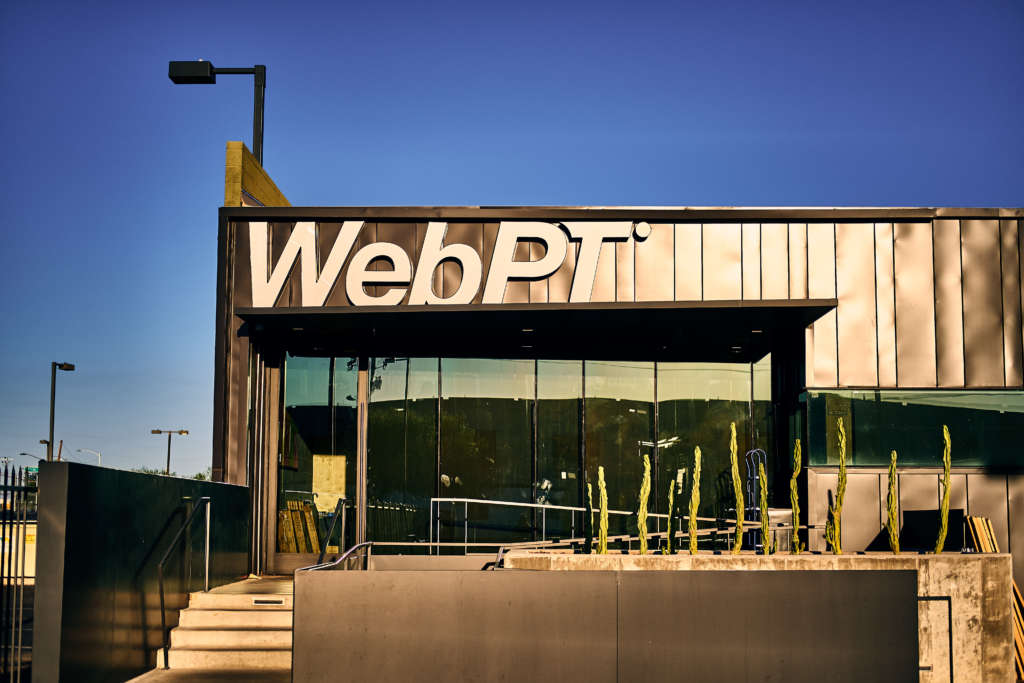
Ascend has grown as WebPT has grown. Last year 350 or so people attended Ascend. This year, approximately 500 people attended. WebPT has grown to about the same number of employees this year. Growth begets further growth. But as I said earlier, this was not like any other conference. It was a 10-year celebration.
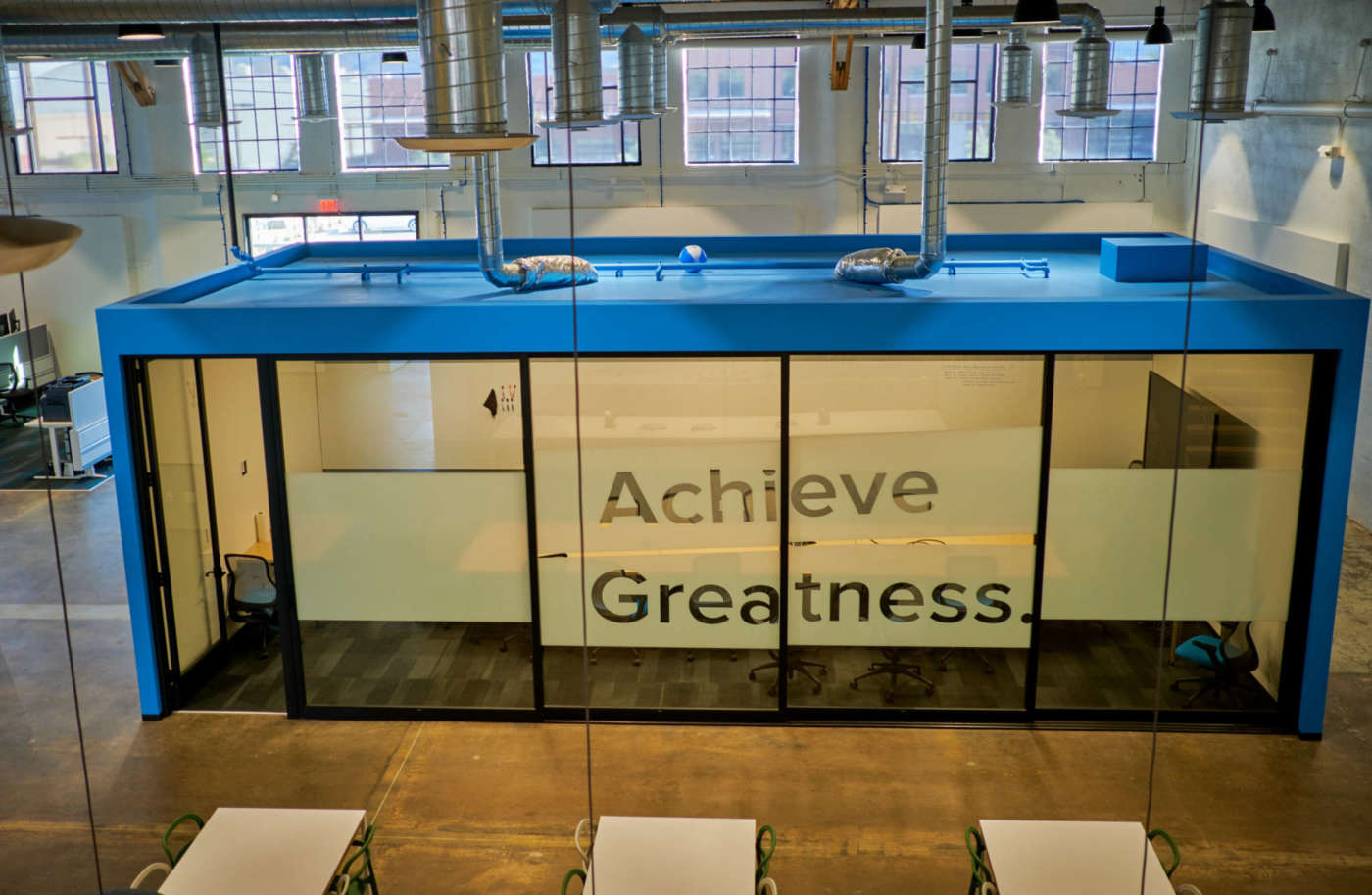
I, along with my business partner Ben Fung, arrived a couple days early and toured the newly moved into 60,000 sqft facility.

Ben Fung enjoying coffee drink
BEN FUNG ENJOYING A COFFEE DRINK
The new HQ, which is a converted warehouse, looks like a tech haven. This facility would feel right at home in Silicon Valley. And while this was a 10 year anniversary, there were scarce reminders of what was. Heidi and WebPT are much more focused on what will be.

NANCY HAM, WEBPT CEO WORKING IN NEW HQ
After spending a day touring the facility and interviewing leadership it became crystal clear that WebPT is going all in to push the physical therapy industry forward.

Time for Ascend

While bigger than ever before, Ascend still feels lean. In the best way possible. It’s a well run, detail focused event. The little things do not get missed. In other words, by attending Ascend you get a taste of what it’s like to be part of WebPT culture.
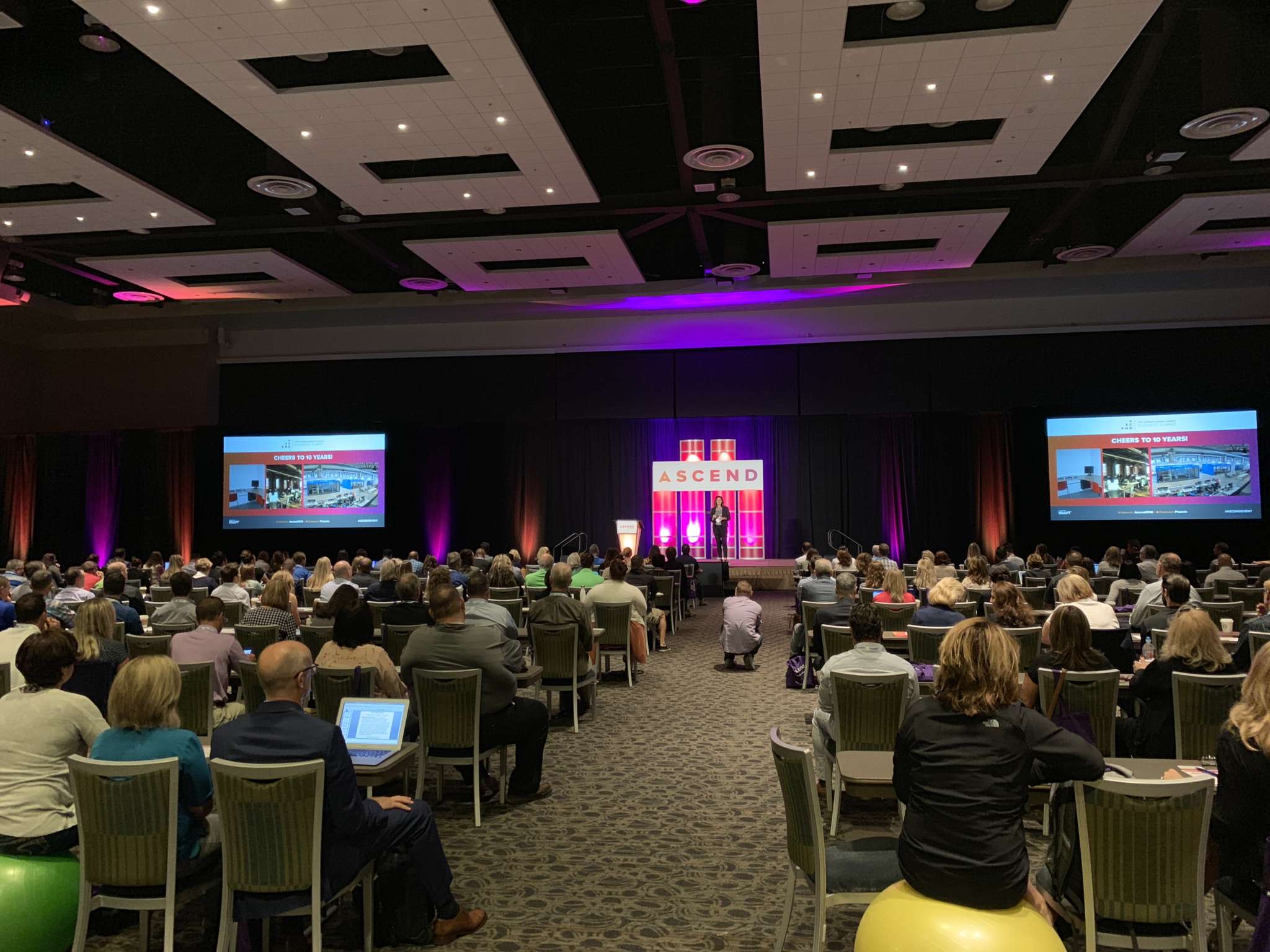
UpDoc media WebPT ascend 2018
HEIDI KICKING IT OFF

Let the show begin

If you base the impact of a presentation on “OOOH” and “AHHH” reactions, then the starting keynote was the clear conference winner. The keynote speaker was David Elton. David is the senior vice president of clinical programs at Optum. He’s a health insurance executive. Hold your collective hissing, please. David shared some staggering statistics. The highlights of David’s presentation were data-based statistics on how much money physical therapy saves. Spoiler alert….A LOT. How much is a lot? Half a billion dollars. Yes, you read that correct (slide image below).
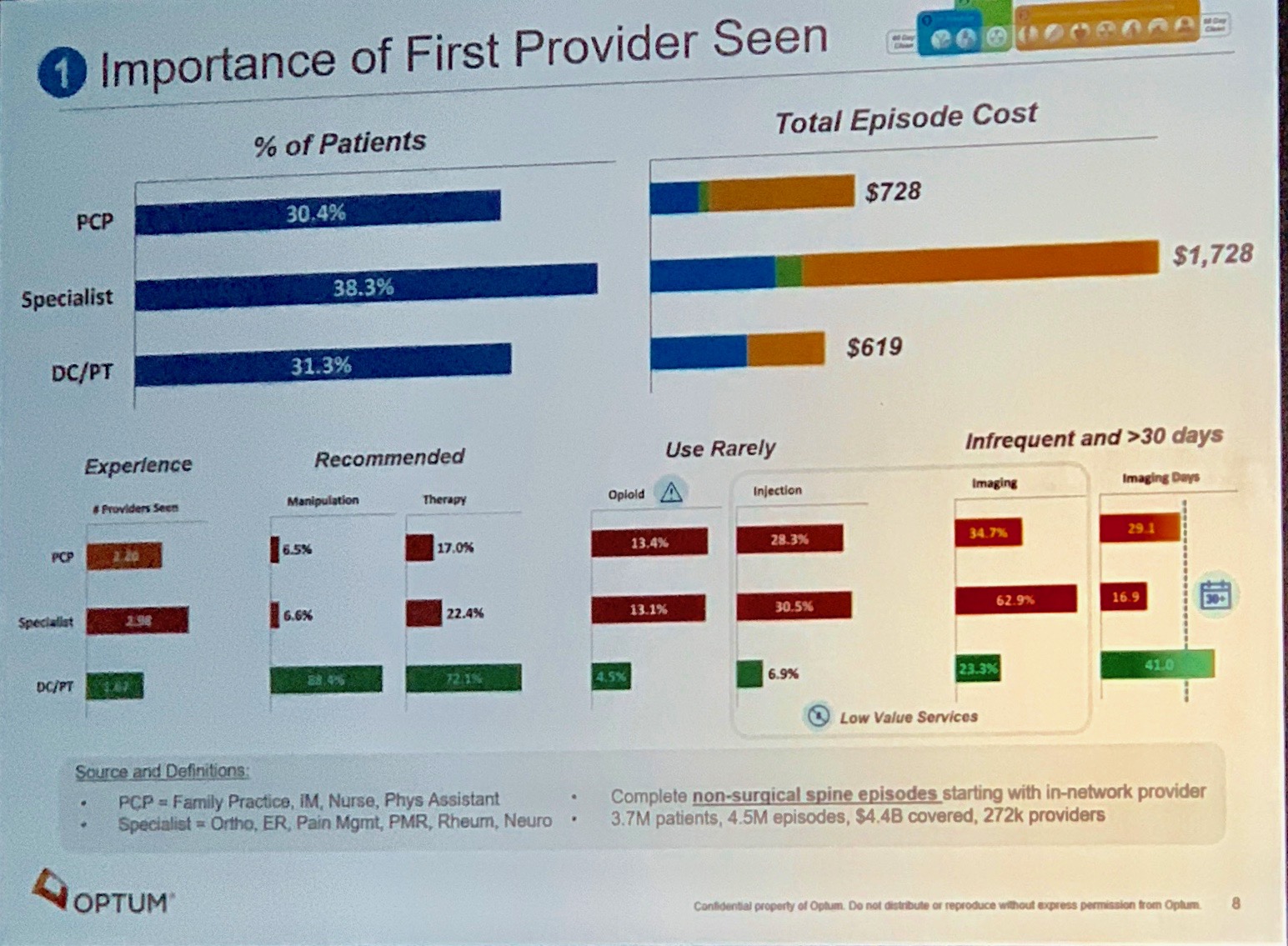
However, the statistic that made the most impact is one that we should all be screaming from the rooftops. Ok, at very least tweeting and posting on Facebook. David referenced a yet to be published study, which was co-founded by APTA. This study, which I was told should be out Fall 2018, has one of the most critical statistics I’ve ever heard about physical therapy. It’s literally life-altering.
Here it is:
If that doesn’t get you excited to be a physical therapist and promote seeing a physical therapist, I truly don’t know what will. People are dying from opioids overdose at a staggering rate. Physical therapists can lower the likelihood of taking opiods by up to 90%! To me that was the most critical takeaway from the conference. But it wasn’t the only one.
Here are a few more takeaways from Ascend.

No one knows what we do

This seems to be a popular rally cry amongst the physical therapy profession. I heard this said countless times during the conference. While this may be true to some extent, a deeper look doesn’t prove it accurate. I’d say more physical therapists don’t know their own potential. Sure, people might not be keenly aware of what we do, yet they all know who we are. That point somehow gets missed. When is the last time you told someone you are a physical therapist and their response was “huh?” My guess is probably never. If you think it’s only semantics, you’re wrong. Hard dollars are backing this up. While we complain about insurance reimbursement going down (rightfully so, the complaining not the declining reimbursements…put your pitchfork down), volume is going up. More and more people are going to see physical therapists. Private equity firms are investing huge sums of money into the physical therapist industry. So where is the disconnect?

If you don’t have optimism, consider opportunism

Physical therapy is a $30+ billion industry. And growing year over year. Physical therapy school is tougher to get into than any other medical profession. Research continues to emerge showing physical therapy being one, if not, the most effective solution of most musculoskeletal issues. AND we only own anywhere from 10% (low back pain) to 25% (all conditions) of the market. In other words, there are still 75-90% of the population not seeing a physical therapist when they should. We are a $30 billion industry with 10% market share. That is insane. This industry is ripe for growth and opportunity. The beauty of it is that our growth benefits our communities. It’s a true win/win. So where is the disconnect?

Talkers take, and doer’s pave

The disconnect seems to be in the never-ending circular rhetoric that is prevalent within our industry. There is a lot of complaining, idealizing, and theorizing. And not enough willing to act, fail, and iterate in order to grow. Talkers take the most valuable resource we have: time. These people within our industry slow innovation because of fear. They may use other words, but ultimately it comes down to fear. Fear of uncertainty. Fear of autonomy. Fear of change.

Ripe for change

Change is scary. Uncertainty is unsettling. Autonomy is powerful. While we’ve spun the rhetoric wheels for a while, the time for change is now. Being at Ascend was a firm reminder of that. WebPT is leading the charge. They understand that the industry needs to evolve and step up. But WebPT is not the only one. I had the pleasure of speaking with so many leaders working to steer their large clinical systems towards the future. These people own companies that have anywhere from tens to hundreds of clinics. They see where we NEED to go as an industry and they are willing to endure short-term pain for long-term gain. And even they are not the only ones. New grads, who are getting burned out from not doing what they sacrificed the majority of the adolescent life going to school for, are stepping up. They are willing to endure extra financial hardships in order to have an opportunity to make a positive impact on their communities. They are willing to act in order to have a chance to eventually recoup those financial hits. And all these people were under one roof because it was 106 degrees outside and no one wanted to be outside.
WebPT is a great example of what great culture, clear messaging, and relentless consistency can lead to. Our industry is on the verge of a similar success story. And we get to be part of writing a chapter of it.
Ascend 2018 updoc media
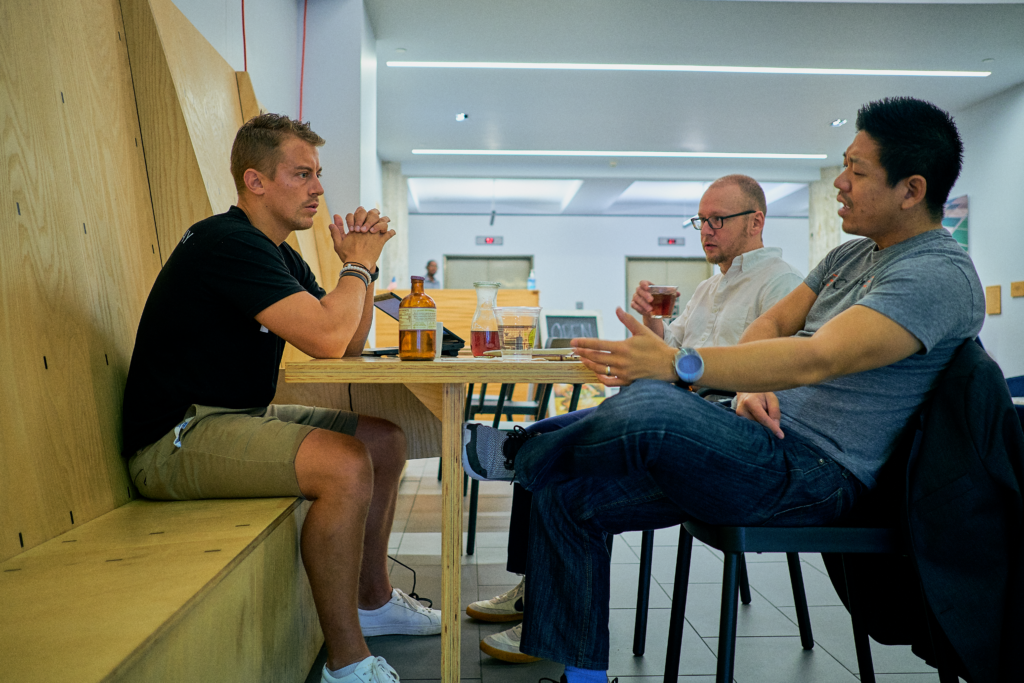
ONE OF MANY MEANINGFUL CONVERSATIONS AT ASCEND 2018 WITH JOSH FUNK, BEN FUNG AND I
 Have questions or thoughts about the article? You can reach Gene on Twitter @therapyinsiders or via email gene@updocmedia.com. 


Want to learn in person? Attend a #manualtherapyparty! Check out our course calendar below!

Learn more online!


Want an approach that enhances your existing evaluation and treatment? No commercial model gives you THE answer. You need an approach that blends the modern with the old school. Live cases, webinars, lectures, Q&A, hundreds of techniques and more! Check out Modern Manual Therapy!

Keeping it Eclectic...

By Gene Shirokobrod

I’ve evolved as a clinician more so in my approach to people than in my accumulation of techniques. 

I went from wanting to fix people to wanting to connect with them. 

Let's take a quick trip back in time to one of my first patient experiences. This was years ago. Before I get into the patient experience, let me paint a little picture of how I got to this clinic. I accepted a job at this clinic months before graduation. While I was in my last year of physical therapy school I went through a year long advanced training program. This program consisted of learning how to diagnose and treat a multitude of musculoskeletal issues. I learned how to access and manipulate (see:crack) any joint in the body. Then I practiced. And practiced. And for good measure, practiced some more. I was ready to fix people. I was eager to start working. To prove myself to my colleagues and to myself. 

The way it worked was we would see patients on our schedule, and read about their situation. At that time we were transitioning from paper files to digital ones. So, it was either a folder or a digital file. I'd grab the folder and read the information that was already filled out by the patient.

Which brings us to Mary (not her real name). She came in with low back pain. A very common problem. In fact, the most common problem. I read the file. Grabbed my folder and went to call her from the waiting room. I saw through the glass window that separated the treatment area from the waiting area, a very uncomfortable young woman. She was shifting and moving in her seat. No position seemed comfortable. It seemed as if the chair was her worst enemy with no intention of losing the battle they were in. I called her name and introduced myself. She seemed very eager to meet me, in retrospect she was most likely eager to stand. We walked back to the treatment room to begin the initial evaluation. 

Every initial evaluation begins with the subjective part. That is when the clinician asks specific questions to get all the pieces of the puzzle on the table. This is a critical part of the exam. By the end of the subjective, a clinician should have a pretty good idea of what's going on. 
Mary had been suffering from low back pain for several months. It progressed from an annoyance to debilitating. She had seen a few other clinicians, and unfortunately, nothing had worked. As I look back on this conversation I'm struck by her answers. At the time I was more focused on her symptoms. 

Let me explain. 

I wanted to get to the source of her pain. After all, I had recently completed a challenging, and all-encompassing year-long course. Her symptoms were like ones I've learned. So, of course, I must know a technique that will fix her. At that time, I needed to figure out what that technique was. 
As she described her problem, despair was predominant in her answers. Instead of saying, "I'm looking forward to jogging again,” she would say, "I'm afraid to walk because it will hurt." Her perspective became of how not to get worse, instead of believing she could get better. 

I finished the subjective assessment and decided that she would benefit from a spinal manipulation (see: back crack). I explained to her what I was going to do and why I thought it would benefit her. She agreed, as most patients do because they trust their clinician. I asked her to lie down on the table, which she did. As the final crunches of the paper covering the table quieted down I asked her if she was ready. She said yes. I bent her knee, rotated her back, and applied a quick downward motion on her low back. A single audible pop from her low back was heard. I mentally high fived myself. Nailed it. Success. I walked away from the table and asked her to stand up to see how she feels. I went to jot down a few notes about the treatment. I heard the paper crinkling as she stood. Then I heard a sound I did not expect. Sobs. 

I put my pen down, turned to see Mary crying. Maybe the mental high five was a bit premature. I began to run through various possibilities in my mind. Did I hurt her? Was I wrong in my assessment? What did I miss? If you are noticing that a lot of my early questions were about me and not her you are not wrong. So after about 10 seconds which seemed like 10 minutes, I finally asked, "what's going on, are you ok?" Her response "Yes, I don't know why I'm crying it's just that I don't have pain right now." Again, not something that I was expecting. We discussed that it's normal to experience an emotional release. She moved around a bit more, tried sitting and finally finished with a few exercises. She felt better. I felt completely confused, and yet happy that I helped her. She came in for 4 more visits over a span of 4 weeks and finished feeling a lot better. 

So why does this encounter with Mary stick out so much for me? All in all, it seems like success, right? She came in with pain, I treated her, she felt better and left. The problem was I fed my bias that it was my technique that helped her. I wanted that technique to help her. I believed it would. Did it have a role to play? Absolutely. And yet, as I treated thousands more patients I began to see things very differently. 

In looking back at Mary and another case that I'll finish out this post with shortly, I realized it was not the technique that helped her. It was the permission to move. Anchors of uncertainty and fear were holding Mary down. She, like thousands of others that I treated, was afraid of what pain would limit her from. Afraid of what they wouldn't be able to do anymore. Afraid of not knowing what a future without control of their bodies would hold. I thought my spinal manipulation helped Mary. In actuality, I helped her by showing her that it was possible to live without pain again and it was ok to move. 

Over the last few years, I've focused a lot of my research and reading on behavioral psychology. I've spent less time on clinical practice and more time on business. Recently, my mom called and asked if I could help one of her friends. He began experiencing back pain. Of course, I'd help I told her. 
We got in touch and were finally able to find a time to meet. I asked him a few questions and asked him to move a bit. Now, our perception of movement changes when pain is present. What he thought he was doing was different than the reality of it. I helped guide him to motions he hasn’t done in over a month. I gave him permission to move again. This permission does not come from a place of power. It comes from a place of safety and trust. He moved to end-ranges. Then came the big test. To do the one task that caused him pain. He was hesitant but willing. He tried it. Minor pain. He tried it again. Less pain. He tried for a bit longer. No pain. He seemed slightly confused and almost apologetic. An almost, "I swear this was crushing my soul the other day, I promise it was really really really bad type of look." He even said, "I wasn't making this up." Of course, he wasn't.

The difference between my approach with Mary and my parent's friend is a culmination of many mistakes and the evolution of thinking. I became less concerned about my ability to fix people, and much more focused on my ability to connect with them. I realized that as a physical therapist, the best thing I can offer people is permission to move. To help them discover the control that they lost. Empowering others creates a relationship based on trust. And starts with simple permission to move. 
I'd love to hear your thoughts.

Leave us a comment on Facebook, tag @therapyinsiders or @updocmedia on twitter.

via Dr. Gene Shirokobrod - UpDoc Media
Want to learn in person? Attend a #manualtherapyparty! Check out our course calendar below!

Learn more online!


Want an approach that enhances your existing evaluation and treatment? No commercial model gives you THE answer. You need an approach that blends the modern with the old school. Live cases, webinars, lectures, Q&A, hundreds of techniques and more! Check out Modern Manual Therapy!

Keeping it Eclectic...

Download file | Play in new window


The only way to grow is by continuing to learn.

How do you decide which is the best option for continued learning?

Continuing education (con-ed) for physical therapy is a necessity. You need to do it to maintain your license. You need to do it to maintain your skillset. You need to do it to simply keep up. How do you choose which con-ed courses to attend? They are often expensive, require travel and integration.

Listen in for the answers.

What do you do when a patient presents with cervicogenic dizziness? How do you go about addressing the problem? How do you keep the patient comfortable? Answers in the podcast.
Is cash physical therapy better than traditional physical therapy? Is spending MORE time with someone equal to spending BETTER time with them? Is there any data to show that more time is better time? Discussion in the podcast.

Keeping it Eclectic...

Download file | Play in new window

There are certain inevitabilities in business. Failure is one we can all agree on.

At some point in your business you will fail.

Physical therapy is no exception. For that matter, any healthcare business is highly susceptible to daily failure. Why? Because in healthcare we regularly interact with people.

For most of us it happens daily. It's akin to baseball. If you hit .300 you are considered an All-star. That means failing 70% of the time puts you in an exclusively, highly successful group.

We embrace failure for what it is, a critical learning experience. We hope you do as well. Some lessons are tougher than others. In this episode, we share a couple stories that exemplify these concepts.

Then we discuss a dangerous tunnel visioned dilemma that experts run in to. It's dangerous because you may not even know it's happening until too late. Find out what the dilemma is and how to avoid it!

Listen in or watch below!


Keeping it Eclectic...


Physical therapy continues to grow and evolve.


My ReCharge Hoco|CrossFit peeps are back again with a quick informative video that you should share with your patients or on your social media. If you really want to get your patients better active treatments should be emphasized over "fixes" like manual therapy.

Even if manual therapies are indicated, they should be framed as initial steps but locking in the improvements require lifestyle changes and movement strategies.

5 Evidenced Supported Ways to Reduce Low Back Pain


Want an approach that enhances your existing evaluation and treatment? No commercial model gives you THE answer. You need an approach that blends the modern with the old school. Live cases, webinars, lectures, Q&A, hundreds of techniques and more! Check out Modern Manual Therapy!

Keeping it Eclectic...