Modern Manual Therapy Blog - Manual Therapy, Videos, Neurodynamics, Podcasts, Research Reviews: Dennis Treubig
Showing posts with label Dennis Treubig. Show all posts

Part 1 of this Post Op Progression Series is here - 5 Considerations for Post-Op Patients

Over my years of practicing, I’ve realized that many clinicians have no criteria for progressing/regressing their post-surgical patient's rehab programs.  They seem to do it randomly or solely based on time or “just because.” And if you’re anything like me, those reasons (especially the “just because”) doesn’t fly.


I don’t think these will come as any surprise to people, but they are often overlooked by clinicians (especially those who work in really busy clinics) and they can play an important role in a session.


I'm going to keep this post short and sweet and let you reflect on this quote and do some deep thinking about it.

I recently came across this quote from legendary strength & conditioning coach Johnny Parker and while he was saying it with regards to training people, it couldn't be more true and applicable to physical therapists too....especially PT students and recent grads.

"They won't care how much you know until they know how much you care."


Read it again a few times and let it sink in.

I wish I had read this quote when I was in PT school and understood the meaning/significance of it back then because it definitely would have helped me get to the point I'm at now a lot quicker.

All that technical, medical mumbo-jumbo some PTs spit at their patients to show them how smart/good they are (I'm looking at you, confident recent grad), won't mean diddly-squat if patients feel their therapist doesn't have empathy and truly understand their current problem and it's effect on their lives.

If a patient feels like just another number, I don't care how "good" your PT skills are, your outcomes aren't going to be that good (or at the very least consistent).

If you truly understand the concept of this quote and put it into practice, I guarantee you will see a difference in your therapeutic alliances, patients' buy-in, cancellation/no-show rates, outcomes, etc.

To learn the soft skills and what patients want/need out of an encounter, check out Modern Patient Education our fully online seminar on recovery/sleep, mindfulness/breathing, nutrition, movement exercise and practical pain science education.


Keeping it Eclectic...


How I Treat My Patients From a Backpack

Can you treat your patients from a backpack?

Do you rely on a bunch of treatment and exercise equipment to treat your patients?

If so, I challenge you to try to treat your patients from a backpack. Think that’s crazy!? Well, I can tell you that it’s entirely possible and I’ve been doing it with success and it feels great to not be reliant on much to be able to get my patients better. And it doesn’t have to be literally from a backpack, like me. What I’m getting at is to challenge yourself to make your hands and brain (and some small tools, equipment, etc.) what you depend on to help your patients.

And yes, I understand there are some patients that this isn’t the best fit for, but you’d be surprised how many people you can help from a “backpack.”

How did I come about this idea? I have a small, side-hustle PT business, Modern Sports PT, that I run out of a CrossFit gym in my area and since space is limited there and due to me wanting to keep overhead as low as possible, I treat patients in a “temporary” space in the gym. Essentially, I set up a table in an area that’s not being used and treat my patients. What this temporary space also means is that I don’t have an area to store supplies or have my own larger equipment (I will say that I do have access to all the gym’s equipment if I need it, but, again, that’s not that often).

So I have to bring everything I would need to treat my patients with me each time (except for my treatment table which the gym owner found a spot to keep it after I break it down). And I don’t want to be carrying a boatload of things with me every time, so I challenged myself to get everything I would need into a backpack. The added bonus of being able to do this, is I can be mobile and provide high-level orthopedic PT from the comforts of people’s homes. And I can also treat family friends “on the spot.”

Now I know you’re wondering what I keep in my backpack, so here is a list (and picture) of everything that’s in there.


Table ($99 from Best Massage on Amazon)

Obviously this doesn’t fit in my backpack but it is needed to treat my patients (and it fits in the trunk of my car). The table I use is by Best Massage and I bought it because it seemed decent and was pretty cheap compared to many others. And I’ll say that it has held up fine and I don’t have any complaints. I don’t keep all the accessories with it, I just have the basic table in the carrying bag. The only modification I made to it was to slap a couple of my company’s stickers over their logo.

Backpack ($99 from Dadgear)
I’m a very neat person and love organization so I wanted a backpack that had lots of compartments and storage space. And at the time I had this idea, my two kids were under 2 and this backpack was what I was using as my diaper bag for them (I wanted my own “manly” diaper bag to use instead of lugging around my wife’s feminine-looking one). So I just ordered another one to use for my PT supplies and I absolutely love it. I’m sure you can find other backpacks that have multiple compartments like this...it was just the phase of my life that I was in at the time.


IASTM Tool - Edge Tool ($115 from edgemobilitysystem.com)
I have been using this tool for ~5 years now and I love it. Great tool, great price. It fits in my back pocket - which is usually where I keep it when treating (that’s how often I use it). If anyone I talk to is interested in using IASTM, I always tell them to buy this tool rather than spend hundreds, if not thousands, of dollars on some other tools.

Albolene (~$15 for 12 oz. tub on Amazon or from local drug store)
This is what I use when using IASTM. I actually buy a 3 pack from amazon and it’s a little cheaper per tub that way. And I get the big tub because I use it that often. I’ve heard of people using cocoa butter too.

Towels ($14 on Amazon)
Basic necessity for obvious reasons - draping, wiping up lotion, etc.

Mobility Bands ($28 from edgemobilitysystem.com)
I love using mobility bands - it amazes me how many times they can improve motion/symptoms so quickly. I’ve had both these bands and a set of Voodoo floss bands and they both work equally well.

“Mulligan” Belt ($9 on Amazon)
I don’t use an actual/official Mulligan belt. I actually bought this 6 ft long gait belt and it works fine for me (mostly use it for hip mobility). And if anyone ever complains of too much pressure on their thigh because this belt isn’t padded, I just put a towel in there.

Rocktape (~$19 a roll on Amazon)
I find kinesiology taping helpful for a lot of people and Rocktape is by far and away the best one I’ve used. It sticks the best and lasts the longest. And patients can get all different colors and designs if they like. I actually buy my tape through Rocktape’s website because I took their course and am “certified” and get tape at discounted price.

Scissors (I'm sure you have an extra pair laying around your house)
To cut the Rocktape...duh. edit - You need a pair of titanium non stick scissors if you're regularly cutting RockTape - here's the ones I use  - Dr. E

Alcohol wipes (couple bucks from local drug store)

To prep an area before putting on Rocktape.


Occlusion Cuff Elite ($130 from edgemobilitysystem.com)
I love using blood-flow restriction training with my patients and the Occlusion Cuff Elite is awesome. It’s so much better than the original version (I’ve used both). The ability to detach the tube enables patient to exercise without having to worry about the tube getting in the way.

Portable Doppler ($140 from edgemobilitysystem.com)
A must-have if you are using blood-flow restriction training on your patients. It enables you to determine the exact Limb Occlusion Pressure so you greatly improve the safety and efficacy of the BFR.

Resistance Band ($16-$45 Monster Band from Rogue Fitness)
I use a green band because I think it’s the most versatile for what I use it for. I mostly use these to show people how to do band-assisted mobility drills. Rarely do I actually use them for resisted exercise, but you could do that also.

Mobility Ball ($15 - from EDGE Mobility System)
To show patients how to use them for self-myofascial release. A lot of times, I’ll give them to patients too.

Suspension Trainer ($60 from edgemobilitysystem.com)
To perform various exercises with patients. I have personally used this suspension trainer and a TRX one over the years and this one works just as well and is less than half the price of a TRX.


Lysol Wipes (few bucks from local store)
To wipe down the table/equipment after each patient. I actually keep these in the pocket of the carrying case for the treatment table.

Empty Plastic Bags (“free” from your grocery store)
To bring dirty towels home to wash.

Binder/Clipboard/Pen (few bucks each from office supply store)
To write down any notes, measurements, etc. In my binder I keep copies of some of the forms I use in case someone didn’t fill them out prior to coming in.

Iphone Tripod ($10-15 from Amazon; lots of available options)
I use this when I’m making a video for a patient of their HEP.

Some things that weren’t in my backpack that you might be wondering about:
Dry needling equipment - in the state of NY where I practice, PTs are unfortunately not allowed to dry needle. I’d imagine you could find a spot in there for this though.

Val-slides - I just use a towel or paper plate (to use on wood floors); you could also use a cheap set of furniture sliders. But I don’t use them that often because I’ll use the suspension trainer instead.

Cupping - I haven’t gotten into cupping, but if you are, I’m sure they don’t take up that much space and could easily be put in your backpack.

Stim Unit - I don’t use TENS for patients but I do like to use NMES to the quad when applicable. But I don’t know of a good, reasonably priced portable unit to use for this. I used to use the Empi 300PV but it broke. If anyone knows of a portable unit that packs a lot of juice like the 300PV did, let me know!

Clinical Notes - I use google drive to do all my notes, paperwork, etc. and it works out well for me. edit - Check out G Suite for Inexpensive EMR 2.0 by Dr E!

Scheduling and Payments - I use the app PocketSuite and it works for the small amount of people I see. It’s free, has a small fee for credit card transactions, and the scheduling features work for me (syncs up to google calendar, sends reminders, etc.)

The roundabout total of all these items comes out to ~$750 (and that’s IF you bought ALL the items I listed). $750 for the ability to treat people wherever you (or they) want is well worth it in my book.

Now that you’ve seen what’s in my backpack, give it some thought and let me know what would you put in your backpack?

What am I missing? I know there has to be more things out there that I could use, so I’d love to hear your suggestions.

via Dr. Dennis Treubig, DPT - Modern Sports PT


Want an approach that enhances your existing evaluation and treatment? No commercial model gives you THE answer. You need an approach that blends the modern with the old school. Live cases, webinars, lectures, Q&A, hundreds of techniques and more! Check out Modern Manual Therapy!

Keeping it Eclectic...


Happy New Year Everyone! I have been on vacation for most of the holidays, out of town, so this post is a few days late, but better late than never! As usual, we had a ton of great blog posts from The MMT Team. Here are the Top 5 MMT Blog Posts of 2017 in case you missed them.

  • most manual therapists (myself included a long time ago) just beat the tar out of frozen shoulders
  • you can't rush true tissue extensibility/length changes any more than you can rush hypertrophy
  • try this Novel Mobilization for a pain free tone reduction which enables the patient to move in a greater range threat free
  • this technique could be a good starter for lateral shifts that are too painful to accept load
  • I used it successfully on an ipsilateral lumbar lateral shift with pain below the knee, normally having very poor prognosis
  • I've since used it as the LCAP - Lateral Chain Arm Pull Test to quantify single limb stance stability and lateral chain strength
  • Dr. Dennis Treubig, star MMT Blogger and inventor of The Knee Terminator as usual dominates our Top posts of the year
  • do you agree or disagree with his list items?
  • it's a build up to why The Knee Terminator is a no-brainer for your post op knee patients, but as such, it was still very close to the top post of the year!
  • honestly, if you use the prone knee stretch for LLLD stretching, you're somewhat of a sadist
  • this used to be one of my favorite go to pin and stretch type techniques; I used to hammer away at it until motion improved
  • this variation gets the same results, but is much faster and is pain free
Thanks to everyone for your comments, questions, shares and support! Live Q&A/mentoring is coming to MMT Premium in 2018 (along with a price hike so now is the time to join before that happens!) See you in the new year, and check out our 2018 Eclectic Approach course schedule here!


Want an approach that enhances your existing evaluation and treatment? No commercial model gives you THE answer. You need an approach that blends the modern with the old school. Live cases, webinars, lectures, Q&A, hundreds of techniques and more! Check out Modern Manual Therapy!

Keeping it Eclectic...


Part 1 of this post can be found here.
Ther-Ex

For the sake of this article, I’ll consider ther-ex as strengthening, dynamic stability, neuromuscular, etc. exercises.
I progress/regress my patients’ ther-ex programs based on my interpretation of the “Soreness Rules” (developed by the University of Delaware PT program for throwing programs) for general ther-ex.  The ‘Soreness Rules” use the presence of and duration of joint soreness after the prior session to dictate progression.  Click here for the official UDPT “Soreness Rules” (used with throwing programs).

Notice, I specifically said joint soreness and not muscle soreness.  If your patient says they were sore after a session, further question them to figure out if it was joint or muscle soreness.  Muscle soreness (DOMS) imposes no limitations and feel free to progress as tolerated.

If a patient complains of joint soreness after a session, the next important question to ask them is how long did that soreness last.  Depending on how long it lasted dictates how I progress them.

Even though I don’t think there is any evidenced-based research about it (sorry EBP police), I have found the “Soreness Rules” to be a very useful way to objectively and safely adjust patients’ the-ex programs.

Here are the “Soreness Rules” as I interpret them for my patients (who don’t come on consecutive days):

No soreness after last session
Eligible to progress
Sore after session but gone by the next morning
Eligible to progress
Sore for ~24 hours after last session
Stay with the same program
Sore for >1 day after last session
Regress program


For Knee Surgery
Another guideline, in addition to the soreness rules, I use when dealing with patients who have had a knee surgery (excluding TKA) is their knee effusion.  Measuring effusion is a simple, easy way to give you more information that will help you safely progress your patients programs.

The way I measure knee effusion is with the Stroke Test - to see how to perform this test check out Stroke Test - How to Objectively Measure Knee Effusion (video included).  I will measure knee effusion before and after the session to see if there was any change

Once you measure and grade their effusion, here are the guidelines:
  • 0, trace, or 1+ → no limitation
  • 2+ or 3+ → ther-ex not progressed
  • If effusion increases more than 2 grades → decrease ther-ex to the level prior to the change in effusion
  • If effusion now present when it was previously absent → decrease ther-ex to the level prior to the change in effusion

Other Factors I Consider
I don’t think these will come as any surprise to people, but often they are overlooked by clinicians, especially those who work in really busy clinics, and they can play an important role in a session.  I’m sure there are other factors that I think about but those are the ones that came to my head.
  • Mood - if someone is just having a bad day, you probably don’t want to add more challenging or increase intensity of ther-ex; you understand what I mean here
  • General health - are they a little under the weather, did they have a bad night’s sleep, etc. - these all get factored in to my thoughts
  • Stress - is the person always stressed out, then you’ll probably have to progress things slower because their body just won’t be able to adapt as well
  • Vacation/special event coming up - you don’t want to add in some new ther-ex if their daughter is getting married the next day, or they’re leaving for a much-needed vacation soon, etc.
  • Prior training experience - this can be a good thing (expect and understand DOMS, technique, etc) or a bad thing (have no clue what to expect afterwards, set/rep schemes, etc)

Summary
So that’s the thought process and criteria that goes through my head when deciding how to progress/regress patients’ programs.  It’s not an exact science or set in stone, but it at least gives me some set of guidelines instead of doing things randomly at will.

Let me know what other guidelines you use!


Want an approach that enhances your existing evaluation and treatment? No commercial model gives you THE answer. You need an approach that blends the modern with the old school. Live cases, webinars, lectures, Q&A, hundreds of techniques and more! Check out Modern Manual Therapy!

Keeping it Eclectic...


Over my years of practicing I’ve realized that many clinicians have no criteria for progressing/regressing their post-surgical patients rehab programs.  They seem to do it randomly or “just because.”  And if you’re anything like me, the “just because” reason doesn’t fly.

So here are the thoughts, criteria, etc. that go through my head when deciding on when/how to progress (or regress) patients rehab programs.  I’m not saying these criteria are the only way to do things or set in stone, rather they are guidelines I use to safely progress my treatments.  Anything has to be better than nothing.

The two main areas I will touch upon are range of motion and ther-ex (i.e. strengthening, neuromuscular, dynamic stability, etc).

Range of Motion

First, let me say that if a surgeon wants certain ROM limitations, then you follow them.  And yes, I’m well aware many surgeons are behind the times and put silly, many times counterproductive, limitations on their patients.

If you feel that it would be detrimental to the patient if you follow the limitations, then I highly recommend speaking with the surgeon.  Maybe there was a reason you weren’t aware of as to why the restricted ROM.  And if there isn’t a good reason and they’re just stuck in the 90’s, I’ll leave that up to you to make the call.  I know that in those instances, many of us “obey” the limitations appropriately with our patient’s best interest in mind.

If there are no restrictions placed on the patient by the surgeon, then the #1 thing I use to gauge ROM progression is end-feel.  It’s really that simple (and complex at the same time).  When assessing someone’s motion, it’s not only important to quantify the amount, but also the quality of the movement and the type of end-feel.

The type of end-feel you get will dictate how you go about your ROM work for that session.  Here are common end-feels and how they affect my progression. For some joints these end-feels are normal and for others they aren’t - the following rationales are for when that particular end-feel is abnormal for a joint:

Hard (bony) and Springy:  don’t push into these end-feels or try to go past it.  It’s hard or springy for a reason that you can’t “fix.”  Instead you can just make it worse and cause more pain for your patient by going ham on them.  It’s like trying to slam a door that has a rock in the way.  You can’t progress this type of end-feel unless the underlying physical restriction is removed.  Example - bone chip(s) in a joint limiting motion, meniscal fragment in the knee.

Soft tissue approximation: the only times I’ve thought of this as “abnormal” for a joint is in obese people. That extra mass ain’t goin’ anywhere anytime soon, so no sense in trying to progress that motion.  I know some people will put motion limited by edema in this category but I think of that as more firm.  Example - hip flexion limited by their gut.

Firm: due to increased tone, soft tissue (capsule, ligament, tendon) shortening; decreased tissue mobility (i.e. from incision).  Many patients will have this type of abnormal end-feel once that initial surgical pain subsides.

This end-feel is where you can perform your manual therapy magic and improve motion, many times without actually stretching them into the limited motion - i.e. myofascial work, IASTM, PNF, MET, repeated motions, etc.  I will “stretch” and progress these joints up to (and sometimes a little past) the firm end feel - making sure to never cause pain.  Example: doing some myofascial work on the pecs, then ranging their shoulder into external (or internal) rotation until you hit the new end-feel, then repeating/or switching to another technique, ranging again, etc.

Empty: this is where the vast majority of post-op patients fall, especially in the early phase after surgery and the end-feel that many clinicians have a hard time progressing.  Mechanically there is no limitation, rather it’s the pain preventing the joint from going farther.  So if you push through the empty-end feel and crank away, you might get some temporary increase in motion, but it will come with the costly trade-off of increased pain/soreness (and probable fear of movement).  And that increased pain/soreness and fear of movement typically causes the patient to not use the joint, guard it, etc - thereby negating the “gains” you just got.

The way to improve motion with an empty end-feel is to modulate the pain and address any underlying restrictions (i.e. joint mobility, increased tone) and then guide the joint through its pain-free range - stopping at the new end-feel.  It sounds simple and cheesy, but use pain as your guide when progressing this end-feel.  Example - using something like IASTM or rocktape or Gr I/II joint mobs to modulate shoulder pain and then guiding it through the new pain-free motion, stopping when it starts to hurt again.

Important Note: Early on in my career, I use to do aggressive joint mobs and crank the shit out of some patients, thinking that “no pain, no gain” method was the way to go.  After a few years of that, I realized that that method wasn’t as effective as I thought it was and in many cases it was actually making people worse...not to mention me tired.  I have gotten to the point now where I don’t want to cause pain with my manual treatments - some discomfort I’m ok with.  If you’re one of those clinicians who is sweating after working on a patient and that patient is near tears during the treatment and super sore afterwards, I challenge you to improve their ROM without ever “stretching” them into that motion - it’s easily doable and, in my opinion, more effective.

Look for part 2 - Ther Ex next week!


via Dr. Dennis Treubig, DPT - Modern Sports PT

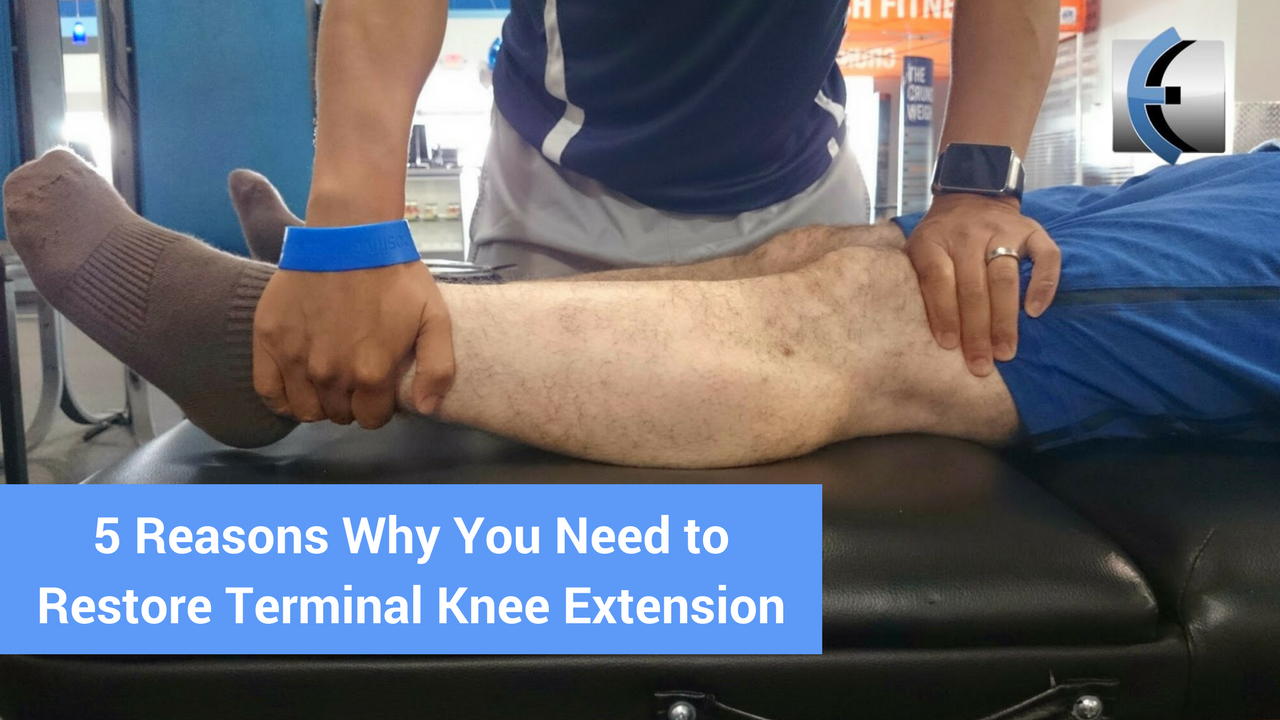
Restoring full terminal knee extension (TKE) should be a top priority if your patients are lacking it.  Functioning/playing without full knee extension motion can cause problems not only at the knee joint but also up & down the kinetic chain.

Why I Hate the Prone Knee Hang Stretch and What You Should Use Instead


Restoring full knee extension can be difficult in some patients (ACL-R, TKA, etc) and there are times when a low-load long duration stretch is called for - obviously in addition to all the other manual techniques and self repeated knee extensions.  The most common LLLD knee extension stretch seems to be the prone knee hang.  Even though it's the most common, I've never been a fan of it and I don't use it on my patients.  

Why I Don't Like the Prone Knee Hang Stretch

  • By putting someone prone for an extended period of time it can increase the patient's anxiety level because they can't see what's going on around them.  And I'm not talking freak out anxiety level, rather an inability to completely relax which is exactly what you are striving for to get the best stretch
  • It's easy for patients to compensate by letting their hips rise/shift and make the stretch not as effective.  So in order to prevent this you have to strap their hips down to the table....thereby further increasing anxiety and not providing the optimal environment for the patient to fully relax
  • It's just not a comfortable position to be in - with your knees hanging off the table, your other leg propped up on a chair (if you actually even do that).  Again, not allowing optimal relaxation to occur.
  • In order to make it a more intense stretch, you have to add weight all the way down by the ankle (long lever arm).  A person's natural reaction to this added weight is to contract their hamstrings, thereby negating the purpose of the stretch in the first place.
  • It takes a good amount of your time to set the patient up correctly - valuable time that could be spent doing other more effective things.
  • The odds that a patient will be able to duplicate this stretch effectively on their own is very low.  It takes a lot to set this stretch up, can only be done in certain areas (i.e. bed), and you can't really get anything else done when you're doing it.  All in all, compliance with this has to be very low and I think it's easy to see why.

The Easier To Set-Up, More Comfortable, and More Effective Alternative

The way I use a low-load long duration stretch to improve knee extension is with the "Knee Terminator" - a device I designed myself because there were no other good options out there.  Below is a picture of it in use (I use an ankle weight or standard olympic weight plate depending on the mood I'm in):

Out of all the options I've tried over the years (prone knee hang, hanging ankle weights from the knee, strapping the knee to the table, etc), my patients said the Knee Terminator was easily the most comfortable method and many have used it on their own at home - when was the last time one of your patients said they did a prone knee hang stretch at home!?

The Knee Terminator requires the least amount of weight to make it an effective stretch because the weight sits directly under the knee joint.  The less weight needed, the more comfortable it will be for your patients...while still being effective.

And the best part about the Knee Terminator is it takes less than a minute to set up - saving you valuable time in your busy day!

How To Set It Up

  • Have your patient is sit in a chair with their foot on a stool/chair/etc. at the same level as the chair they are sitting in.
  • DO NOT let their heel rest on the stool because it will force them into dorsiflexion which will tension the gastrocs and limit the amount of knee extension they will get.  You should put a half-foam roll (or rolled up towel) under their achilles - this allows their ankle to plantarflex which takes any tension out of the gastrocs.  Tip - Even after you instruct patients to let their foot relax, most of them will slowly gravitate back towards a dorsiflexed position, so check on them every few minutes.
  • Then just put the Knee Terminator on and add the desired weight and you're done!
  • Typically, I start off with 5 lbs for 6-8 minutes.  And as they can tolerate more, I increase the weight and/or time - I can't recall ever going over 10 lbs or 10 minutes and it still gives great results.

Why the Knee Terminator Is the Best Option Out There

  • Easier for the patient to relax (HS/gastroc muscles and overall) making it more effective
  • More effective because the weight is directly below the knee (so not as much weight is needed)
  • Easier for the patient to set up on their own at home (and actually be performed correctly)
  • Patients can do other things while in this set-up (read, watch TV, interact with others, talk to their therapist/other patients, etc.) - making it more likely to be performed
  • Compliance is a lot higher due to all the above reasons
  • A steal ($39.99) compared to other much more expensive apparatuses out there that cost over a $1000.
  • Patients have flat-out told me this set-up is better than anything else I've tried

Keeping it Eclectic...


It's that time of the year again! By that, I mean it's a holiday in the US, so the team needs to take a break from writing and shooting all our awesome content. If you missed any of it this year, here are our Top 5 Posts of the First Half of 2017.

  • by Dr. Peter Malliaras of Tendinopathyrehab.com
  • Peter's posts have been very popular and welcome on MMT Blog as they provide a great insight and clinically applicable information for Tendinopathy

  • need to improve shoulder elevation, but many of your go to techniques are uncomfortable?
  • this is a great variation on a classic technique that uses PNF to make the technique pain free and greatly reduce perception of stretch and tone

  • this was a recent but very popular post
  • true frozen shoulders are slow responders and I have been guilty in the past just like many other clinician in trying to hurry the process along
  • while typically we cannot drastically improve their mobility rapidly, we can modulate pain, decrease tone, and get them moving better in all planes with much less perceived threat

  • this was one of my favorite posts of the year as I discovered this technique as kind of a last ditch effort to correct an ipsilateral lateral shift
  • I've since started this as an assessment for people with recurrent loss of ability to accept load in the LQ or with single limb stability issues (it's not just glut med weakness)
  • I'll shoot that video soon as it's become part of my "chains" assessment


  • ahhh controversy never fails to be popular
  • What does contributor Dr. Dennis Treubig think should be retired from the PT profession along with my quick list?
Thanks to everyone for reading this year, sharing, and all your comments and questions. Keep them coming and to everyone in the US or if you happen to have an upcoming holiday, have a great time with your friends and family!


Want an approach that enhances your existing evaluation and treatment? No commercial model gives you THE answer. You need an approach that blends the modern with the old school. Live cases, webinars, lectures, Q&A, hundreds of techniques and more! Check out Modern Manual Therapy!

Keeping it Eclectic...


Seeing as how some of my prior posts have been about why I think SLRs, pulleys, and pendulums should be eliminated from the PT world, I figured I would put this question out there:

Name 5 things you think should be retired from the PT profession/clinic?

It can be a technique, exercise, rationale, concept, term, piece of equipment, etc. Just off the top of my head for me would be:
  1. ultrasound 
  2. pulleys 
  3. pendulums 
  4. SLRs (for strengthening) 
  5. "VMO training" 
There are many more I could list, but those were the first 5 that came to mind.

And if you listen to the Therapy Insiders podcast, we know that Gene will undoubtedly say "polos."

I think the best way to keep this conversation going is by using #PTretirementparty (or a different hashtag if you can think of a better one - #PTgraveyard #PT cemetery)

- Dennis, Modern Sports PT

edit: Dr. E's list
  1. Passive intervertebral motion testing
  2. Trigger point ischemic release
  3. Deep friction massage
  4. Provocation testing (that is not ligamentous)
  5. Pathoanatomical explanations for pain

So what are your 5? Comment below!


Interested in live cases where I apply this approach and integrate it with pain science, manual therapy, repeated motions, IASTM, with emphasis on patient education? Check out Modern Manual Therapy!

Keeping it Eclectic...


Thanks for helping make 2016 one of MMT Blog's biggest yet! We had just short of 1 million visits this year! I still remember the milestone of 1 million hits about 2.5 years into blogging! Now we hit that annually!

In 2016 we launched the MMT Team of bloggers, many of whom instantly had huge hits that made this Top 5 list. I also launched my Untold Physio Stories short form podcast with Jason Shane, and Therapy Insiders Podcast had our biggest year yet!

Stay tuned for some big announcements in 2017, including partnering up for more courses under the MMT Brand (Corporate Wellness, Strength Training, Motor Control to name a few). We're psyched for 2017 and couldn't have made it this far without you.

  • sometimes stretching improves mobility - other times it does nothing but beat a dead horse
  • if stretching activates the neurotag association of strong stretch, discomfort or pain, often mobility does not improve
  • in this post, I go over ways to improve hip mobility using isometrics, repeated lumbar loading and more
  • does passive intervetebral (or any passive movement assessment) really enhance your clinical decision making?
  • or do you use it just because that's what you were taught?
  • Dr. Christine Walker's debut on MMT was one of our biggest posts of the year (and ever really)
  • people like simple assessments that help you dictate treatment, and the Child's Pose falls into that category
  • check out Christine Walker's awesome Therapy Insider's Podcast here while you're at it

Want an approach that enhances your existing evaluation and treatment? No commercial model gives you THE answer. You need an approach that blends the modern with the old school. Live cases, webinars, lectures, Q&A, hundreds of techniques and more! Check out Modern Manual Therapy!

Keeping it Eclectic...