Modern Manual Therapy Blog - Manual Therapy, Videos, Neurodynamics, Podcasts, Research Reviews: Dave Tilley
Showing posts with label Dave Tilley. Show all posts

Get ready for a powerful origin story with Dr. Dave Tilley of Shift Movement Science. Dave, one of Erson's original group of online mentees has since gone on to be one of the major voices in rehab and gymnastics social media, as well as being the first outside PT hire at Champion PT and Sports Performance in Boston. What lead up to his success? Was it only hard work? Or too much hard work? After listening, if you know anyone or yourself are going through something similar, please reach out to Dave on social media or his site!


Untold Physio Stories is sponsored by

EDGE Health and Tech Solutions - we level up your website with full SEO optimization, turn it into a referral generating machine and do full G Suite and Telehealth integrations

Modern Manual Therapy Insiders - over 650 Exclusive videos, Research Reviews, Webinars, Online Discussion - learn easy to apply Clinical Practice Patterns, integrate Pain Science with Manual Therapy and Patient Education

Also, be sure to check out EDGE Mobility System's Best Sellers - Something for every PT, OT, DC, MT, ATC or Fitness Minded Individual 

edit: this post was first found on Shift Movement Science, an awesome blog by my good friend Dr. Dave Tilley, DPT. If you listen to Untold Physio Stories podcast, you'll know I'm a HUGE fan of failure stories and what we can learn from them. Dave's story here is powerful and well worth a read! - Dr. E


In the 12 years that I have been coaching gymnastics, I have been lucky to experience some incredible moments. Like when one of our gymnasts hits a huge routine at Regionals and qualifies herself to nationals, causing everyone to erupt in celebration. Or the tear-jerking moment when a graduating senior tells a room packed full of parents and young gymnasts – “I am proud of the person I have become thanks to our gym, the coaches, and gymnastics as a whole.”

In contrast to this, I have also had experienced some truly awful moments of regret. Today I would like to share the lowest moment of my coaching career, in an effort to help you not make the same mistakes I did.

It came when I received a phone call from another one of our soon to be graduating seniors. Through her tears,  she told me that an MRI had just revealed two severe stress fractures in her back, that she was quitting gymnastics, She would no longer be pursuing her dream of competing in college, which she had been working her entire life for.

Her parents had made her go to the doctor because along with the chronic back pain she was ” just trying to push through”, she started having shooting leg pains that made her unable to drive, sit in school, or put her socks on. After deciding with her family that gymnastics was too dangerous for her long-term health, she would now be changing schools so her family could save money.

I remember literally not being able to formulate words. Adrenaline surged through my body, and I instantly felt like I wanted to throw up. After finishing the conversation in a pretty much numb state, I hung the phone up and stared blankly at my computer for 25 minutes. Every negative feeling and negative thought you could imagine ran through my head. “How did this happen? Do her parents hate me? Am I an awful coach?”

The worst part? I was also her Physical Therapist. This happened the year after finishing my doctoral work in PT, when I was in my first year of both coaching and treating full time. Not only was I responsible for training decisions that contributed to her fractures, I was the one who was supposed to be fixing her fractures.

Now there were many factors over the years that likely accumulated to her career-ending back injury. But one thing is for sure – the toxic combination of lacking self-awareness and a massive ego blinded me to see the clear red flags that her back pain was not just “part of gymnastics”.

Thankfully, upon years of reflection and reverse engineering that terrible situation, the injury rate at our gym is fractional compared to the rate that it was when this occurred. Accidents still happen, and we do have gymnasts who battle lower back issues, but they are much less severe and come with less collateral damage. Here are 5 valuable coaching lessons that had I known then, her and I may have had a much happier 6-month end to her gymnastics career.


1. Ego Is The Enemy

Credit to Ryan Holiday, who wrote the incredible book Ego Is the Enemy.  I have come to realize that my large ego as a younger coach likely caused hundreds of gymnasts I worked with to not reach their full potential, or to get hurt. During my current travels, many people tell me that they are impressed with my work ethic and humility. Well, now you know where it comes from. It took this gut-wrenching experience for me to realized I was, unfortunately, making some training decisions based on how I would look, not how our gymnasts would feel. I now try to weave humility into my moral fabric every day . I strongly recommend that coaches who are just starting out do the same. 

2. Embrace Reality, and Deal With It

All credit to Ray Dalio on this. The gymnast I mentioned had months of warning signs that I chose to not act upon. Again, my ego was allowing me to believe that I should not acknowledge the situation because it would make me look bad. Being a coach with gymnasts who have back injuries isn’t a great look for a PT who is supposed to be an expert in preventing back injuries. The take away is this: Fires don’t turn to ashes just because you chose to look away. They turn into raging wildfires. The sooner you look at your problems in the eyes, the better.

3. Do The Harder Thing, Especially When It’s The Harder Thing To Do. 

I know more than anyone else, as a coach it is incredibly uncomfortable and anxiety provoking to really look at the things that terrify you. I was scared to tell this gymnast “I don’t know”, I was scared of what people would say or think about me, and I was scared to own up to the reality of her injury progressing. If I had followed Steps 1 and 2 early and admitted there was a problem, her and I would have had a much happier 6 month ending to her gymnastics career.

4. The “Ivory Tower” Is a Lonely and Dangerous Place

The Ivory Tower is an expression for people who think they are better than others and possess a sense of entitlement. During this time period of coaching, I thought that I was special because I had a doctorate and knew a lot about the medical field. All this did was create resentment in the coaches and gymnasts I worked with, rightfully so. When I was spewing out big medical words to sound impressive, they would roll their eyes at me and gossip behind my back. The only thing I gained from living in my big Ivory Tower was a more painful fall from grace when I finally opened my eyes. Now, I try my best to practice empathy and hear our people’s point of view whenever possible. I openly tell our gymnasts, coaching staff, and the parent’s they have full permission to call me out if I’m acting like a jerk (so long as it’s delivered professionally)

5. Learn, or Lose

I saved this for last because it really encompasses all the points above. From the more technical learning (new drills, new business tactics, how to spot a skill) to the more “meta” learning (self-awareness, reflection, perspective taking) there should never be a day you don’t sponge up new knowledge. Even if it’s about something you have done for 10 years and could do in your sleep. There may be a better way, a new way, or a more efficient way. In our current age, technology changes at a blistering pace and new ideas are surfacing every day. Gymnastics is no different. If you don’t physically build in time for learning in your calendar, your doing yourself and the gymnasts you work with a huge disservice. I didn’t have the tools I needed to help this gymnast, and I paid the price. Now, I block one hour of continuing education first thing every morning.


The Problem with Gymnastics Education

Building off number 5, I feel people’s frustration with not having the time, access, or money for new gymnastics education based on the actual problems they face working in gymnastics.  Everyone in gymnastics tells me that trying to find new information online is exhausting at best, and when they do find something it is either impossible to implement during practice or they are unsure about the science behind it.

To solve this problem, I built a brand new online gymnastics platform called The Hero Lab that gives people monthly gymnastics webinars based on requested topics, a discussion forum to get help with their everyday struggles, and an international network of gymnastics professionals. I want people to have all the tools they need to be happier during training, help their gymnasts, and build incredible gymnastics cultures, right at their finger tips.

The Hero Lab absolutely exploded when I launched it yesterday. We had a huge range of gymnastics professionals from across the world join including Olympic and elite level coaches, Registered Nutritionists, expert medical providers, PhD level Mental Health Professionals, and more.

I wanted to make sure you could see what all the hype is about, so you can learn more by clicking below. I PROMISE you do not want to miss out on this.

The Wait is Over – The Hero Lab is Officially Here!


Have a great week,

Dave

Dr. Dave Tilley DPT, SCS, CSCS

CEO of SHIFT Movement Science


Want to learn in person? Attend a #manualtherapyparty! Check out our course calendar below!

Learn more online!


Want an approach that enhances your existing evaluation and treatment? No commercial model gives you THE answer. You need an approach that blends the modern with the old school. Live cases, webinars, lectures, Q&A, hundreds of techniques and more! Check out Modern Manual Therapy!

Keeping it Eclectic...

There are a few issues in gymnastics that I think every coach, athlete, and parent recognizing as a problem. One of the most common is the concept of rib flaring. This refers to a shape that has an over-arched lower back, and usually comes with the ribs sticking out quite a bit.

In my years in gymnastics, I have seen hundreds of gymnasts struggle with this rib flare issue during skills. I have also the same issue related to lower back pain, elbow pain, and wrist pain. When you take a step back and look at the overlapping movement issues, sometimes there are some common denominators that are important to look for. To help readers out, here are the top 5 reasons I see for rib flaring in gymnasts and the relation to some common injuries.

1. Limited Soft Tissue Mobility

I feel like I talk about limited soft tissue mobility in a ton of blogs. But it’s for good reason, as I think not regularly tending to soft tissue on a daily basis is one of the biggest things most gymnasts miss. The lat muscles run from the upper arms, travel down the back, and then end right above the hips. It is a very powerful muscle the pulls the arm forcefully down, and rotates the shoulders inward (think kipping, swinging on bars, pulling into flip shapes).

What many people don’t realize is that when they are excessively stiff, it’s really easy for a gymnast to cheat their way around the limited flexibility. Gymnasts usually over arch their lower back causing the rib flare, buckle their knees early when swinging their arms overhead in tumbling, or impact without their handstand shoulder angle fully open.

The teres major is another muscle that goes from the inner arm to the shoulder blade, and is also mainly responsible for aggressive motions pulling the arm down as well as turning the shoulder joint inward.


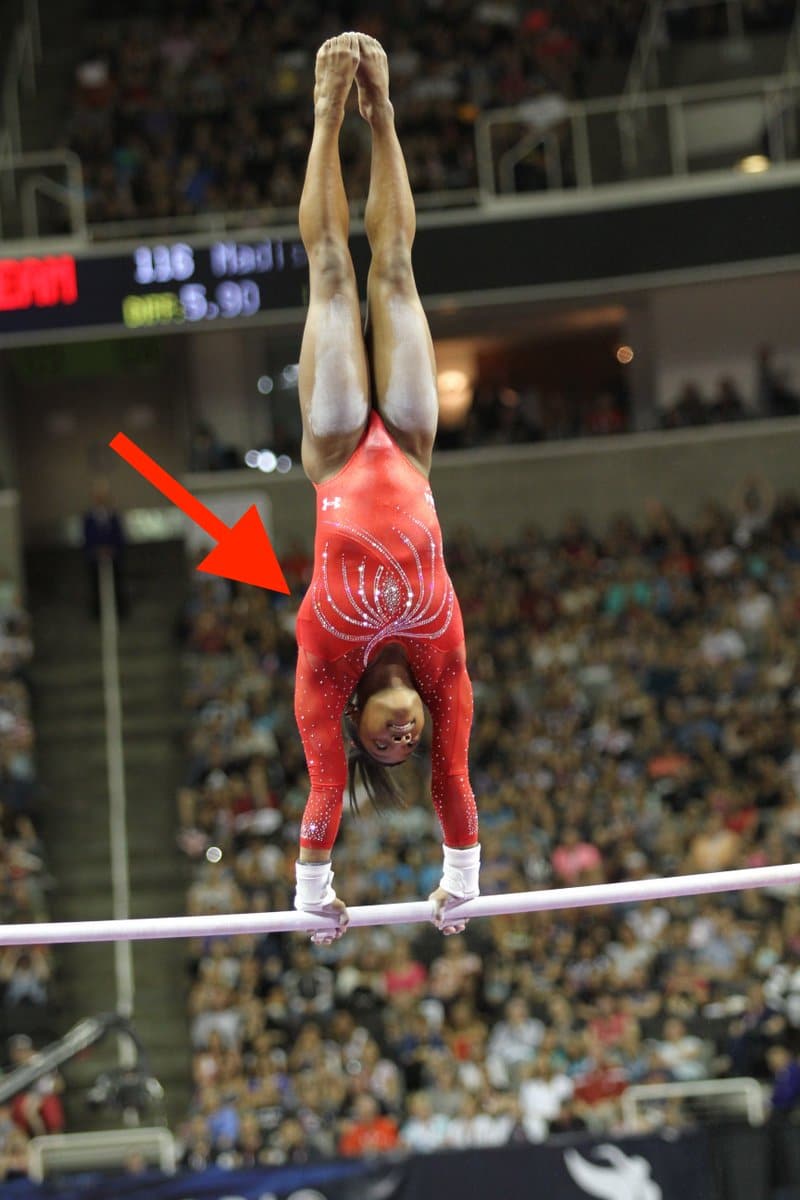
The lat and teres major are very easily over worked and stiff in gymnasts due to how much they use this motion. As a result, you often see the same rib flare compensation from above. The other really common compensation you see is the shoulder blades winging out to the side during handstands. The most common place to catch this is in uneven bar handstand holds, especially front giants. You can actually see it pretty well in Simon Bile’s left shoulder in this handstand.


I have no idea if this is the case with Simone, but given it being so common in gymnasts I would think so. She is just beastly strong in her core and can maintain a good line, but you can see the shoulder blade flaring out during her handstand.

With teres major stiffness, this is often a common compensation during overhead skills. In both of lat and teres major stiffness, the rib flare is seen and may appear to be the problem. However, the real issues it the soft tissue being overly stiff. When people address these issues, the positive changes in handstand lines is pretty crazy. First, we have to screen gymnastics specific shoulder positions. Following this I usually have the gymnast start with foam rolling and lacrosse ball work to these two areas, perform some under grip stretches, and then follow it up with some strength or handstand technique work.


2. Strength Imbalances Around The Shoulder

This is another really common issues I find myself talking about a lot. Just as with the point above, it’s really easy for gymnasts to have some areas of the body (lat, teres, pecs) that are naturally stronger, while other areas (upper back, scaps, posterior chain) tend to get neglected. This is partially due to the nature of gymnastics, but also because sometimes as a whole we neglect them in strength.

The best way to correct this is to first address the soft tissue above, and then make sure to add in regularly horizontal pulling exercises during strength. I try to get 1-2 pulls in for every push each week, and this is always a main focus of rehab in gymnastics patients I treat at Champion. Horizontal Rows, Renegade Rows, and some basic dumbells exercises are usually my go to.


<
/center>

3. Core Control / Strength Issues

I think this is the most intuitive for all gymnastics coaches, gymnasts, and medical providers. Sometimes, gymnasts simply don’t know how to engage and maintain proper core engagement during skills. This often times creates a situation where they buckle during the skill, and have a really poor core and shoulder position.

If the soft tissue problems have been ruled out about, and they are relatively balanced, it may take just breaking down some basic core control aspects. I personally usually like having gymnasts go on their back, and practice basic breathing/bracing. We do 3 rounds of this (takes a total of 60 seconds) in our warm up every day, so that it helps transfer to events.

Once they get the basics, you can then move to the harder strength, technique, and power based applications to prevent the rib flare from creeping in. I try to focus a lot on this during strength, power, and side station drills as most coaches would. Sometimes it just takes a ton of practice applying it to skills and routines.

4. Technical Issues

This one is quite a broad topic, as there are a ton of technical skill issues that could come up. Many times, gymnasts may have the flexibility and strength for certain skills, but it’s just new and they don’t have a ton of experience. This is where it comes down to having a good coaching eye, being able to explain the issue to the athlete, and then applying the right drills or cues to help correct it. Often times 1 step back can lead to 3 steps forward, and some light bulb moments. I also think that slow motion video feedback is a huge learning tool in these situations.


5. Fatigue 

This one is most commonly overlooked as an issue, but people don’t realize how much fatigue ca negatively affect proper shaping/movement patterns. If a gymnast is getting really fatigued or doesn’t have the cardio to get through routines/practice, the rib flare and a loss of core control may be the first thing to go. Especially during high intensity cardio situations, rib flaring is usually the first way the body trys to get more oxygen in and carbon dioxide out.

To help, I’m a huge fan of using “pet rock” workouts during cardio. This idea of holding two weights while resting during a cardio circuit forces gymnasts have to maintain proper core engagement, breathing patterns, and also try to slow their heart rate down. I think it’s really great when used appropriately to help control rib flaring under fatigue. You can see it in this example below, where our girls had to do some horizontal rows, jumps, block pushes, and jump cast handstands, and then immeditaley do a kettlebell hold for 60 seconds when fatigued.

Want To Learn More?

If you want to get more information this, as well as a ton more exercise/video content, be sure to sign up for the SHIFT Insider Newsletter. It is jam packed with information to help increase gymnastics performance and reduce injury risk.

Sign up for Shift Movement Science Self Myofascial Release Checklist Below!
Powered by ConvertKit


Concluding Thoughts

So, these are just a few of what I find to be the most common reason for rib flaring in gymnastics. There are definitely some more reasons that could go on this list, including some gymnasts that have unique anatomy any larger rib cages /over extended spines that are more pronounced. I typically find this not to be as common as some people think though. These categories are not mutually exclusive, as sometimes it can also be a combination of a few factors. For now, I hope this helps!

via Dave Tilley DPT, SCSCEO/Founder of SHIFT Movement Science and Gymnastics Education


Want an approach that enhances your existing evaluation and treatment? No commercial model gives you THE answer. You need an approach that blends the modern with the old school. Live cases, webinars, lectures, Q&A, hundreds of techniques and more! Check out Modern Manual Therapy!

Keeping it Eclectic...


Post originally found at Shift Movement Science

Explosive lower body power and the ability to dissipate high force are both crucial factors for gymnastics success.  On the women’s side, 3 of the events are primarily leg driven with substantial benefit given to those athletes that express and absorb high force. On the men’s side, huge tumbling passes and notable increases in vault / dismount difficulty have demanded athletes develop more lower body power than years before. Around this time of year in the fall, many coaches are looking to increase power as competitive season gets into full swing.

Before I go on and offer some exercises I use, keep in mind this is a monstrous topic. Rather than dive into the physiology of power development, plyometrics, and specific mechanisms of energy transfer, I will instead offer readers 4 great resources to check out. I highly recommend people look into them, as they have been essential in helping me learn more about this area. They cover important areas like fast twitch fiber type, contraction physiology, glycolytic metabolic pathways, neural motor unit recruitment, and more. It may seem a little dense, but understanding the physiology and mechanics directly relates to exercise selection, rep/set ranges, periodization models, and long term individualized progression/regression for athletes.

The Physiology of Training for High Performance 

Strength and Conditioning for Sports Performance 

Essentials of Strength and Conditioning Training : 4th Edition

There are many factors aside from exercise selection that go into increasing power output in gymnastics. Hundreds of other factors such as underlying strength base from a previous training cycle, skill technique, tissue quality, age/developmental status, nutrition, recovery, periodization models, and more impact power output. This must be considered when outlining power programs. Also, I certainly did not invent these exercises. Some come from multiple sources, and others are my own tweaks. With that said here are 5 exercises (and some variations) I program on a weekly bases with the gymnasts we coach or during advanced stages of training for gymnasts in a rehabilitation setting.


1. Single Leg Jumps From Box (no counter movement)

Following a strength cycle in the summer / early fall, usually my first go to type of exercise are jumps that start from a static position and have no arm counter movements or preloading swing phase. The main purpose behind this is that I want to focus on isolating the legs for power development, rather than allowing the upper body or momentum to assist.

In theory, this type of training forces the nervous system and muscle being worked to learn how to rapidly fire (through motor unit discharge) and create acceleration force relative to body mass. It is much more challenging at first and may not seem very explosive, but I feel it is an important building block to help newly created leg muscle learn to work in a faster, more coordinated manner.

I like to utilize an appropriate height based off the athlete, both from a forward and side position as seen below. Usually 5-7 reps are my starting point, with the athlete focusing on perfect movement quality, maximal height and power intention. In between sets they can do a few other exercises (core, upper body, etc) to allow regeneration of their legs before the next set.

Two legged variations can also be used and they can also be progressed to double box jumps.

2. Single / Double Leg Jumps with Whole Body Involvement

The natural progression of the first category of exercises is to start incorporating the whole body. Not only does this allow for more total body power output, it also teaches the athlete how to transfer energy efficiently through the legs, to the core, and out through the upper extremities. This is ideally what ends up transferring more fluidly to gymnastics specific power exercises and skills. As always, quality of the movement and proper technique under fatigue is the most important factor.

I will make an important note that the box level has to be appropriate for the athletes height / skill. I see all too often that athletes are using boxes that are way too high for their own good. It often leads to dangerous landings, and quite honestly takes much away the purpose of the power drill in my mind.


3. Kettlebell Swings

In my personal opinion, I think weighted hip lifts and kettle bell swings should be staples in every gymnast’s training program. The basics of these movements can be developed at a very young age (hip hinging drills, kettlebell deadlifts) and through progression benefits can still be seen for elite level athletes. First, gymnastics requires a huge amount of lower body hip extension power across many tumbling, bar, and shape changing skills that these exercises directly assist with.

Second, powerful hip extension is essential in helping de-loading the lower back against extension based pain during high force skills. This also links to the discussion on the ability to dissipate high forces during landings. Properly taught / programmed hip lifts, kettle bell swings, and squatting or lunging variations can help increase capacity to handle these forces and reduce injury risk.

There are a lot of coaching steps and technical aspects to doing a proper kettle bell swing, but I feel the return on investment is ten fold. The best thing a gymnastics coach can do is either hire a strength coach to teach these exercises, or invest in their own continuing education to become proficient in applying them. The other benefit to kettle bell training is that there is a world of beneficial progressions that can be used off of the swing when properly taught.

I feel the progression to a kettle bell swing is very important and needs careful teaching, but there are other regressions that gymnasts can use while they learn the mechanics safely. These include single leg hip lift jumps, as well as single leg hip lifts with an opposite leg kick to help transfer to jumps/leaps.

4. Single Leg Bounding Jumps 

Following more dynamic jumps or whole body drills, I like to start incorporating more ballistic bounding or plyometrics jumps. From running, to single leg hurdling, to floor tumbling or jump/leap connections, to the inevitable non symmetrical landings, training single leg bounding and plyometric training is a must.

I feel it must be done in proper progression, and also with the right periodization / dosage model to not risk overload based injuries. Following strength cycles, I like to put a lot more bounding and general plyometric training into preseason to help prep for more intense meet preparation. I try to start with static single leg bounds in place, and then move forwards  (sagittal) sideways (lateral), and diagonal or rotational (transverse) type exercises.

5. Depth Drops to Max Height / Max Distance Jump

Another form of bursted plyometric training I like to use are depth jumps followed by max height / max distance jumps. I like these because they teach fast reaction off the floor, but also place emphasis on max effort and power output. These drills (along with many above) can help train both the neural stretch reflex and passive elastic tissue rebound for increased output.

Many gymnasts in circuits tend to have one or two good power jumps, then slowly fade off trying to survive metabolically as power drops off. I think it’s important we separate these two athletic components (power/rate of force development and metabolic capacity) to give them separate attention they need. It’s also important note to remember, factors like the box height, contact time, reps per set, days per week programmed, and total volume must be monitored. It’s very easy to let the volume spike up leading to overuse type soreness or a limited performance progress.


So, I hope that is helpful for people looking to get some new ideas. Many other great drills exist beyond this, as I continue to learn more each year. Until next week, best of luck.

– Dave Tilley DPT, SCS


Want an approach that enhances your existing evaluation and treatment? No commercial model gives you THE answer. You need an approach that blends the modern with the old school. Live cases, webinars, lectures, Q&A, hundreds of techniques and more! Check out Modern Manual Therapy!

Keeping it Eclectic...


Every gymnast, gymnastics coach, strength coach, and medical provider knows that appropriate core development is essential for success and reduced injury in gymnastics. There are hundreds of gymnastics specific core strength exercises to pick from (presses/stalders, L holds, leg lifts, planks, arch/hollow rocks, etc), many of which need to be done on a regular basis. However, as I have progressed and learn more in the last 5 years I have found huge success in implementing many “non gymnastics” based core drills also. They have also become a staple in my advanced rehab and return to sport phases when working with patients. Here are 5 of my favorites that I feel the gymnastics community should learn more about, and properly implement with their athletes.


1. Basic Core Bracing and Breathing

Even though basic core control drills aren’t as glamorous as L hold rope climbs, it is absolutely essential that gymnasts master these basics and work them daily. A gymnast must know how to engage their core while maintaining proper breathing patterns (more diaphragm and less upper chest breathing) in a relatively neutral alignment. Many gymnasts default to over hollowed, over extended, or faulty core control/breathing strategies when attempting skills. Without revisiting and stressing these core basics, it makes it very challenging to properly work any higher level gymnastics specific core strength exercise. I highly recommend readers first teach their athletes, and then add them in daily. They are an essential part of our warm up that only takes 2 minutes.


2. Plank Kettlebell / Dumbell Drag Throughs 

I got last year this from some of my strength coach friends, and immediately started programming it once a week in our strength. The main reason that I love this exercise is because it takes a traditional (pretty boring) front plank and adds both a rotational and weight shifting component. I think it has great application to bar and floor twisting, as well as helping to build in an upper body pulling component for scapular strength.

3. Medball Slam and Throw Variations

I wrote about med ball slam variations a few months ago in this article, but still continue to see huge benefit to them. Standing medball slams are great for dynamic core control and tumbling/shape change application, and overhead medball throws are great for teaching a hip open setting technique. I will say I have been using much more 1/2 kneeling medball diagonal throws than diagonal slams, in an effort to help it transfer to an “up and over” type floor and vault twisting technique I learned from many great national team coaches. The key for these are building on the basics above, and using lighter weight with high power/intent to encourage rapid rate of force development.

4. Loaded Carry Variations

Loaded carries have become very popular in the strength and conditioning world through the last 5-10 years. After learning from friends of mine and understanding how to coach them, I think loaded carries have a ton of benefits for gymnastics. It can bias certain aspects of the core, teach proper breathing mechanics and control under loaded tension, and are a fantastic way to develop metabolic capacity when programmed during the right energy systems workout. There are many variations but farmer, suitcase, front rack, and overhead carries tend to be my 4 go to for our team. Overhead carries in particular develop great single arm loading that is essential for pirouetting and tumbling skills.

5. Sled Push/Pull Variations 

Similar to above, sled pushing and pulling variations go hand in hand with loaded carries. They are great to  integrate leg strength or power development with core strength. Pushes can help bias anti extension core strength, pulls can help bias anti flexion core strength, and lateral sled drags can go a long way for anti – side bending and glute medius/minimus development. As with other exercises, there are a ton of great ways to make these harder or easier depending on the athlete you are working with.

Want To Learn More About Developing Core Strength and Power?

If you liked this post and want to learn a ton more about gymnastics core development, increasing shoulder/hip flexibility, preventing lower back pain, and training with cutting edge scientific methods, be sure to check out my brand new e-book, “The SHIFT Gymnastics Educational Series: Vol 1” that was just released. For this week only it is at a special discount of 25% off, so don’t miss out! You can click the link above to learn more, or the “Get Instant Access Now” to instantly get your hands on a copy.

The book has 230 pages, 7 Chapters, and 300+ full color photos that outlines all of the work I have done in gymnastics up to this point. Inside I go over hundreds of more exercises and training concepts for the gymnastics community to utilize, along with lots of current medical/strength research that fuels my ideas.

book-cover-2
instant-access

That’s all for now, and I hope this post was helpful!

– Dave Tilley DPT, SCS


Interested in live cases where I apply this approach and integrate it with pain science, manual therapy, repeated motions, IASTM, with emphasis on patient education? Check out Modern Manual Therapy!

Keeping it Eclectic...