Modern Manual Therapy Blog - Manual Therapy, Videos, Neurodynamics, Podcasts, Research Reviews: pain science education
Showing posts with label pain science education. Show all posts
Untold Physio Stories Podcast - Options for Non Responders Part 1 - themanualtherapist.com


On social media, a listener/follower asked, "How do you motivate a non-motivated non-responder with chronic issues?" This episode, Erson gives his answer which is realistic, but not easy to hear. These types of patients are difficult for the best clinicians. Maybe feeling better, but being stronger and more functional if you change every aspect and bad habit, and maladaptive beliefs is not an easy selling point.


Untold Physio Stories is sponsored by


Helix Pain Creams - I use Helix Creams in my practice and patients love them! Perfect in combination with joint mobs, IASTM and soft tissue work. Get your sample and start an additional revenue stream for your practice. Click here to get started.


Check out EDGE Mobility System's Best Sellers - Something for every PT, OT, DC, MT, ATC or Fitness Minded Individual


My PT Insurance - Insurance just got easier. check out the self employed and employed plans. Easy sign up and coverage that follows you wherever you practice in the United States. Save $20 if you sign up using our link.


Keeping it Eclectic...

Untold Physio Stories - Our Favorite Pain Science Stories Part 2 - themanualtherapist.com


Having trouble explaining why the hips or pelvis doesn’t go in and out of place? These two simple and powerful true stories often help patients realize how strong and resilient their bodies are.

Untold Physio Stories is sponsored by


Helix Pain Creams - I use Helix Creams in my practice and patients love them! Perfect in combination with joint mobs, IASTM and soft tissue work. Use code MMT2 to get your sample and get an additional revenue stream for your practice. Click here to get started.


Check out EDGE Mobility System's Best Sellers - Something for every PT, OT, DC, MT, ATC or Fitness Minded Individual


My PT Insurance - Insurance just got easier. check out the self employed and employed plans. Easy sign up and coverage that follows you wherever you practice in the United States. Save $20 if you sign up using our link.


Keeping it Eclectic...

Untold Physio Stories - Our Favorite Pain Science Stories and Analogies Part 1 - themanualtherapist.com

In this episode, Erson gives two of his favorite ways to explain to patients and to clinicians how pain is all about sensitivity and not necessarily about structure or damage.


Untold Physio Stories is sponsored by


Helix Pain Creams - I use Helix Creams in my practice and patients love them! Perfect in combination with joint mobs, IASTM and soft tissue work. Use code MMT2 to get your sample and get an additional revenue stream for your practice. Click here to get started.


Check out EDGE Mobility System's Best Sellers - Something for every PT, OT, DC, MT, ATC or Fitness Minded Individual


My PT Insurance - Insurance just got easier. check out the self employed and employed plans. Easy sign up and coverage that follows you wherever you practice in the United States. Save $20 if you sign up using our link.


Keeping it Eclectic...

Untold Physio Stories - Why Does Manual Therapy Work? - themanualtherapist.com


Sometimes the hardest thing standing in the way of change is your own success. Listen to Erson and Andrews’s origin stories and what happened when Erson recently debated a successful manual therapist online. 


Untold Physio Stories is sponsored by


Helix Pain Creams - I use Helix Creams in my practice and patients love them! Perfect in combination with joint mobs, IASTM and soft tissue work. Use code MMT2 to get your sample and get an additional revenue stream for your practice. Click here to get started.


Check out EDGE Mobility System's Best Sellers - Something for every PT, OT, DC, MT, ATC or Fitness Minded Individual


My PT Insurance - Insurance just got easier. check out the self employed and employed plans. Easy sign up and coverage that follows you wherever you practice in the United States. Save $20 if you sign up using our link.


Keeping it Eclectic...

Does Arthritis Cause Low Back Pain? - theManualTherapist.com


👀Does Arthritis Cause Low Back Pain?👀
You Can Win at Pain Science - themanualtherapist.com


In this episode, we're joined again by Jon Crowley. Like many clinicians, after taking a Pain Science Education Seminar, he couldn't wait to get amazing results by "talking" away everyone's pain. Multiple failures into the process, he had an amazing win that really made him realize, maybe there is something to this Neuroscience Education.


Untold Physio Stories is sponsored by


EDGE Health and Tech Solutions - we level up your website with full SEO optimization, turn it into a referral generating machine and do full G Suite and Telehealth integrations


Modern Manual Therapy Insiders - over 650 Exclusive videos, Research Reviews, Webinars, Online Discussion - learn easy to apply Clinical Practice Patterns, integrate Pain Science with Manual Therapy and Patient Education - Join now!


Also, be sure to check out EDGE Mobility System's Best Sellers - Something for every PT, OT, DC, MT, ATC or Fitness Minded Individual


Keeping it Eclectic...

5+1 Steps for Reconceptualizing Pain with Exercise - themanualtherapist.com


Many individuals with pain can become fearful of movement, or exercise, if it appears to provoke symptoms. 

Having the knowledge that exercise can be beneficial despite pain, here are 6 practical steps clinicians can take to reconceptualize this fear.
6 Steps for Reconceptualizing Pain-Related Fear Through Exercise by Cameron Faller


👉Step 1: Understand What The Patient Understands - Provide questions that elicit information about their beliefs and perceptions as to why they have pain in the first place.

👉Step 2: Challenge Unhelpful Beliefs - Question their beliefs about their safety with exercise. Prescribe exercises or movements that were previously avoided/or painful as new associations may form that inhibit prior fear.

👉Step 3: Enhance Self-Efficacy - Ask them their level of confidence when performing a specific exercise. Discuss what might occur when they perform that exercise. Begin with easier exercises and progress to more difficult ones which may build better self-efficacy.

👉Step 4: Provide Safety Cues - Validate reasons as to why tissues may be sensitive given disuse. Provide information about building tolerance and strength to carry over towards functional deficits.

👉Step 5: Provide Advice on Suitable Levels for Pain - Find an acceptable and tolerable level of pain for your patients and try to keep exercises within its range. Educate on recovery and having symptoms calm down over 24 hours modifying if pain persists longer than that time period.

👉Step 6: Provide Advice on Exercise Modification - Find the sweet spot. Don’t make activities too easy that have no functional carryover. If an exercise is too painful, educate on ways to reduce load, modify range, or change position to decrease symptom provocation.

Exercise has many therapeutic benefits mentally and physically especially for individuals in pain. Don’t let pain be a barrier to receiving successful outcome

via @camfallerdpt and @modernpaincare - reposted with permission


Learn more online - new online discussion group included!


Want an approach that enhances your existing evaluation and treatment? No commercial model gives you THE answer. You need an approach that blends the modern with the old school. 
  • NEW - Online Discussion Group
  • Live cases
  • webinars
  • lecture
  • Live Q&A
  • over 600 videos - hundreds of techniques and more! 
  • Check out MMT Insiders
Keeping it Eclectic...

5 Steps to Reframe Maladaptive Beliefs and Misconceptions - themanualtherapist.com


🔥TOP 5 FRIDAYS🔥

Patients often present to the clinic with a variety of preconceived beliefs and perceptions that will shape their experience.

The beliefs that we hold are often critical and essential to the identity we display. But what happens when those beliefs are built from irrational theories and are detrimental towards their health?

As health care practitioners, it is not only important for us to help patients make sense of their pain but it is pertinent that we address any maladaptive belief guiding them towards a more logical way of thinking.

However, if you really think about how you came to believe the things you feel are important, you would know it didn’t happen overnight. 

So don’t expect the same for your patients. Instead, develop a process where you slowly integrate new thoughts and ideas into their mind allowing them to rationalize them into new beliefs.

Here are 5 steps in accomplishing this difficult task as described similar to the art of planting a flower with a patient who believes their back is damaged and will not heal: 
5 Steps to Reframe Poor Beliefs and Misconceptions by Cameron Faller


👉Find a Healthy Environment - Ensure the patient is willing and ready to accept new ideas and may be open to conversation. 

👉Plant Some Seeds - Begin by skillfully planting seeds (ideas) that may contradict or falsify their belief.

👉Add Adequate Water and Nutrients - As the patient starts to become skeptical, utilize contextual factors to slowly add in support for a new belief.

Keep it Cared For - Continue supporting 👉any new beliefs by helping your patient rationalize their initial experience and thought process justifying why it may have been incorrect

👉Watch it Thrive - Motivate your patient to hold onto new beliefs by reminding them of all their accomplishments and improvements from when they first began.
Via Cam Faller's Instagram


Learn more online - new online discussion group included!


Want an approach that enhances your existing evaluation and treatment? No commercial model gives you THE answer. You need an approach that blends the modern with the old school. 
  • NEW - Online Discussion Group
  • Live cases
  • webinars
  • lecture
  • Live Q&A
  • over 600 videos - hundreds of techniques and more! 
  • Check out MMT Insiders
Keeping it Eclectic...

Untold Physio Stories - The Ecosystem Matters - themanualtherapist.com

In this episode, Erson recounts a difficult case where a colleague of his has a toe injury that leads to persistent neurotags, pain, and frustration. The solution took years, and everything the current evidence tells us to do was attempted. In the end, the patient realized the issues with recovery were even more nuanced. What do you think?


Learn more online - new online discussion group included!


Want an approach that enhances your existing evaluation and treatment? No commercial model gives you THE answer. You need an approach that blends the modern with the old school. 
  • NEW - Online Discussion Group
  • Live cases
  • webinars
  • lecture
  • Live Q&A
  • over 600 videos - hundreds of techniques and more! 
  • Check out MMT Insiders
Keeping it Eclectic...

5 Rules for Exercising People in Pain - themanualtherapist.com

A big misconception within the therapy world is that all exercises should be pain free. It is easy to assume that when an exercise is painful, you might be causing further damage or disrupting the healing process. However, that is almost never the case, especially with lower loaded interventions.

First, we know that pain and damage are not highly correlated. Pain is an experience that consists of a multitude of central and peripheral mechanisms in which the relationship between pain and the tissue becomes less predictable the longer pain persists.

Second, for individuals managing persistent musculoskeletal pain, the literature supports a small, but statistically significant benefit of painful exercises over pain free.


This does not mean that as clinicians we need to be preaching “No Pain; No Gain.” But what it does suggest is that we are able to reconceptualize pain-related fear through exercise.

In order to set up success for your patients, these are general rules of thumb I describe and establish early on to guide us through the recovery process.
  1. Pain Must Be Tolerable
  2. Pain Should Return to Baseline, or Diminish Upon a Determined Time
  3. Avoid Increasing Symptoms More than 2 Points on a 0-10 Scale
  4. Avoid Reaching Levels Where Moderate Swelling is Noticed
  5. Avoid Reaching Levels Where Sleep Becomes Disrupted More than Usual
These rules are left fairly vague so that you can individualize all the parameters towards each patient you work with. Some patients are comfortable reaching higher levels of pain and some are able to show quicker recovery times.

Allowing pain with exercise is a process and not something you will have figured out the first time. With this, it is important you continually discuss with your patients about what they have noticed has improved, and what remains challenging.

Participating in shared decision making, keeping functional measures as a primary objective, and being willing to modify these rules based on each patient’s response will help guide you towards success.

Posted with permission from Cameron Faller's Instagram

Want to learn in person? Attend a #manualtherapyparty! Check out our course calendar below!

Learn more online - new online discussion group included!


Want an approach that enhances your existing evaluation and treatment? No commercial model gives you THE answer. You need an approach that blends the modern with the old school. 
  • NEW - Online Discussion Group
  • Live cases
  • webinars
  • lecture
  • Live Q&A
  • over 600 videos - hundreds of techniques and more! 
  • Check out MMT Insiders
Keeping it Eclectic...


The 5 E's of Pain - themanualtherapist.com


Our understanding of pain has always been derived from reductionist and inaccurate thought processes.

Beginning with the Cartesian body-mind dualistic perspective and even transitioning into the biopsychosocial model, we try to reduce pain into a specific classification mainly focusing on pathoanatomical (biological) causes of pain while neglecting any other psychosocial influences.

In order to reconceptualize pain into a new framework, the enactive approach was proposed which aims to understand pain while avoiding any dichotomization or trichotomization classification, along with incorporating a first-person experience.

Stilwell and Harman have eloquently illustrated the enactive approach by discussing the 5 E’s of Pain:
the 5 E's of Pain by Cameron Faller


👉Embodied - Recognizing that experiences [pain] are not only physical in nature but are shaped by the physical, cognitive, and social immersion depending on space, time, and ultimately future action

👉Embedded - Interpreting each situation based on the background contexts and surrounding environment

👉Enactive - A relational interaction between the body, brain, and environment that shapes a meaningful world that is determined by the goals, needs, and capacity of the former

👉Emotive - A way we engage with, interpret, and make sense of the world through 'desiderative feelings of affective framing'

👉Extended - A coupling of biological processes with external processes that shape and contribute towards our consciousness and cognition

“Saying that pain is in the brain is like saying flight is in a bird’s wings. A brain is needed to have pain and wings are needed to fly – but to understand pain or flight, one needs to consider the whole picture and the relational nature between things like a person (with a body/brain) and their social/environmental context; or the bird and the atmosphere. It follows that the experience of pain will not be found in the blood, brain, or other bodily tissues. The tissues in the body or the networks in the brain are not the key to pain – instead, they are pieces of a larger system that is adapting and striving to sustain into the future. This always involves the environment that we shape and that shapes us.”


Learn more online - new online discussion group included!


Want an approach that enhances your existing evaluation and treatment? No commercial model gives you THE answer. You need an approach that blends the modern with the old school. 
  • NEW - Online Discussion Group
  • Live cases
  • webinars
  • lecture
  • Live Q&A
  • over 600 videos - hundreds of techniques and more! 
  • Check out MMT Insiders
Keeping it Eclectic...

5 Ways to Reframe your Narrative Around SI Joint Pain - themanualtherapist.com

When patients present with non-specific SI joint or low back pain, symptoms are more likely present due to sensitivity versus any dysfunction.

Low evidence exists with our ability to perform clinical tests as very little movement actually occurs during normal activities (0.2-0.5 degrees). This raises the idea that the perception of tiny movement could be attributable to other factors such as soft tissue motion or pain-associated muscle activation as a response to nociceptive activity.

Given this challenging paradigm, here are 5 ways to manage and change the narrative around SI joint-related pain.
Narrative of SI Pain by Cameron Faller


👉Identify Patient Beliefs about their Pain - With the SI Joint being an inherently stable structure with very minimal movement, many patients still come in with the belief they are broken and damaged resulting in pain

👉Avoid Communicating Fragility Messages - Describing the pelvis as unstable or out of place not only is unsupported by the evidence but also sends messages of fear that can be linked to avoidance behavior which in turn can sustain pain and disability

👉Help Patients Make Sense of their Pain - Provide explanations that aid in patients being able to reconceptualize their pain in a way that promotes functional recovery and avoids reinforcing negative behaviors

👉Align Treatment Rationale with Explanation about Pain - When performing techniques, avoid blaming symptoms on specific tissues and keep messages consistent with education regarding pain (i.e. explain that manual is performed for improved neurophysiological mechanisms and not necessarily to mobilize the pelvis)

👉Provide Reassurance with Clear Expectations of Recovery - Reassure patients that their pelvis is inherently strong and stable, and oftentimes the road to recovery may take some time but they do not have to live with intolerable pain

Education is vital with management and clinicians should carefully consider their role in perpetuating implausible pathoanatomical diagnoses

Know someone who might find this helpful? Tag or Share!

“Aspire to Inspire”


Learn more online - new online discussion group included!


Want an approach that enhances your existing evaluation and treatment? No commercial model gives you THE answer. You need an approach that blends the modern with the old school. 
  • NEW - Online Discussion Group
  • Live cases
  • webinars
  • lecture
  • Live Q&A
  • over 600 videos - hundreds of techniques and more! 
  • Check out MMT Insiders
Keeping it Eclectic...

5 Facts About Exercise Induced Hypoalgesia - themanualtherapist.com


EIH has been widely studied in both pain free individuals and persons with persistent pain showing both short term effects initially after one exercise session, with other evidence suggesting longer term higher pain thresholds after consistent activity.
Kinesiophobia…What? Why? How? - themanualtherapist.com


KINESIOPHOBIA IS OFTEN MENTIONED WHEN DISCUSSING PERSISTENT PAIN, BUT WHAT IS KINESIOPHOBIA?  AND HOW IS IT RELEVANT TO PHYSIOTHERAPY?

Pain-related fear is proven to be a predictor of ongoing disability in those with persistent pain, and is more predictive than pain intensity or structural findings (Vlaeyen, Crombez, & Linton, 2016; Vlaeyen, Haazen, Schuerman, Kole-Snijders, & van Eek, 1995; Waddell, Newton, Henderson, Somerville, & Main, 1993).

This was first mentioned by Lethem and colleagues (1983), with the “fear-avoidance” model attempting to explain why some patients react more strongly to pain than others.

The Fear-Avoidance Model illustrates that when a painful event is believed to be threatening, it can create catastrophising thoughts that movement and activity will result in further pain and reinjury (Larsson, Ekvall Hansson, Sundquist, & Jakobsson, 2016). As this continues, this becomes avoidance behaviour, causing disability, deconditioning and depression, creating a vicious cycle of fear and perpetual pain (Larsson et al., 2016).

Fear Avoidance Model - Vlaeyen (2016)

Fear Avoidance Model - Vlaeyen (2016)

Kinesiophobia was first coined by Miller and colleagues (1990), as an aspect of the fear-avoidance model. Kinesiophobia is ‘‘a condition in which a patient has an excessive, irrational and debilitating fear of physical movement and activity resulting from a feeling of vulnerability to painful injury or re-injury’’ (1990, p. 36). It is now defined as a fear of movement, due to the fear of re-injury (Lundberg, Larsson, Ostlund, & Styf, 2006; Vlaeyen et al., 1995), with individuals who are highly fear-avoidant believing pain to be a sign of bodily harm, and that any activity causing pain is dangerous and should be avoided (Hapidou et al., 2012).

RELEVANCE TO PHYSIOTHERAPY

GENDER DIFFERENCES

Persistent pain is becoming increasingly more common, with chronic low back pain and neck pain being the highest cause of disease burden in Australia (Hoy et al., 2014). As previously mentioned, kinesiophobia is a stronger predictor for persistent pain than pain severity or radiological findings.

So kinesiophobia is a predictor of pain becoming persistent…should we then screen every patient for kinesiophobia?
Are there patients who are predisposed to kinesiophobia, and therefore more likely for their pain to become persistent?

Persistent musculoskeletal pain is more prevalent in females, in both the general population and in those seeking treatment (Stubbs et al., 2010), with response to treatment differing between genders (Wijnhoven, de Vet, & Picavet, 2006).  It is documented that females are more sensitive to pain, describe higher pain intensities and report widespread pain more often than males (Popescu, LeResche, Truelove, & Drangsholt, 2010). Females use more analgesia, and report depression rates twice as high as males (Munce & Stewart, 2007). However, males tend to display lower quality of life levels and generally score higher on kinesiophobia testing (Rovner et al., 2017). Rovner and colleagues (2017) conducted a study subjecting males and females to the same painful stimulus and reported the differences between genders. Surprisingly, both genders reported experiencing the same severity of pain, but males displayed higher kinesiophobia, disturbance of mood and lower activity levels, while females described stronger social support, pain acceptance and higher levels of activity.

Based on this, although females have a greater propensity to develop persistent pain, males appear more likely to display kinesiophobia, with females more likely to display depression. While it may not be necessary to screen every patient, it appears more relevant to screen males for kinesiophobia, while screening females for depression and anxiety (Rovner et al., 2017).

SURGICAL INTERVENTION

KINESIOPHOBIA IS A PIVOTAL PREDICTOR OF PERSISTENT LOW BACK PAIN, BUT IS THERE ANY DIFFERENCE BETWEEN THOSE WHO UNDERGO SURGICAL INTERVENTION AND THOSE WHO RECEIVE CONSERVATIVE MANAGEMENT?

Svensson and colleagues (2011) investigated kinesiophobia in patients following discectomy surgery. Patients completed questionnaires following surgical intervention, assessing kinesiophobia, quality of life, pain levels, disability, function and patient satisfaction. Almost half the patients recorded high scores on the Tampa Scale for Kinesiophobia (TSK), while all other data was comparable between groups (age, gender, location of herniation and place of birth) (Svensson et al., 2011). Those displaying high levels of kinesiophobia had poorer outcomes in all aspects measured, with greater disability, greater pain, more depression symptoms, lower self-efficacy and more catastrophising thoughts than those without kinesiophobia (Svensson et al., 2011). The follow-up questionnaires were completed 10 - 34 months post-surgery, yet still had almost 50% of individuals displaying kinesiophobia (Svensson et al., 2011).

Patients with kinesiophobia tend to have more depression, with pain being closely linked to depression. The study found more than 50% of those who described anxiety or depression pre-surgery felt the same post-surgery (Jansson, Nemeth, Granath, Jonsson, & Blomqvist, 2005; Silverplats et al., 2011). Depression also appears to independently predict poor outcomes post-surgery (Svensson et al., 2011). Since kinesiophobia can be a cause of depression, based on Vlaeyen’s fear-avoidance model (Vlaeyen & Linton, 2012), preventing kinesiophobia may reduce depression symptoms.

It appears imperative that all patients be screened for kinesiophobia following discectomy. Given almost half the participants displayed kinesiophobia, it seems almost every second patient will display fear avoidance. If their kinesiophobia is not addressed, it is expected they will suffer higher pain levels, have greater disability and lower quality of life.
Fortunately, a study by Sullivan and others (2009) showed addressing psychological factors pre-surgery improved post-surgical disability and pain levels. While this study only investigated knee surgery, it appears relevant to extrapolate the data to low back pain.

By routinely screening individuals for depression and kinesiophobia, before and after lumbar surgery, and addressing those who display high levels of depression and kinesiophobia, physiotherapists should be able to reduce pain levels and disability following lumbar discectomy surgery.

ASSESSMENT

TAMPA SCALE FOR KINESIOPHOBIA

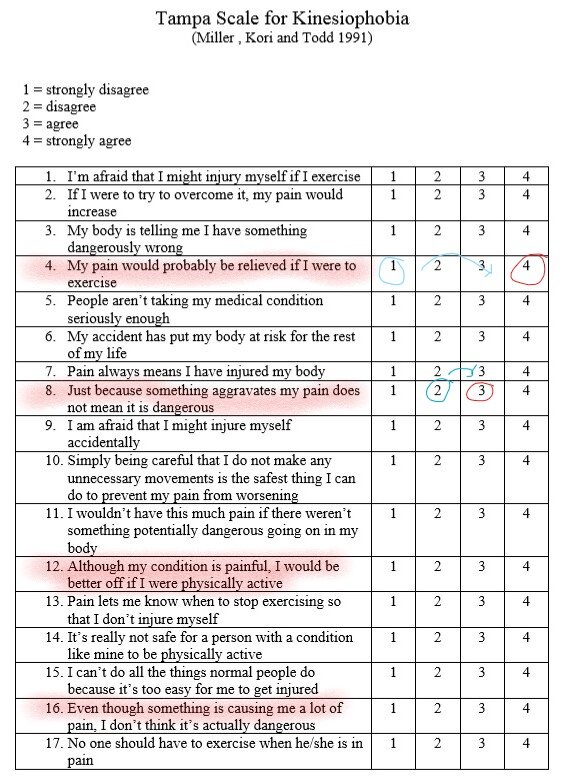
The Tampa Scale for Kinesiophobia (TSK) was designed by Miller and colleagues in 1991, in an attempt to quantify the extent of kinesiophobia in individuals.
The questionnaire has 17 questions, with a short form of 11 also available.

The full form is shown below, with the patient circling the number that most applies to each statement. The therapist must then invert the scores of question 4, 8, 12 and 16, for example if the patient scores 1 on question 4, this must be counted as a score of 4. Or if a patient scores 2 on question 8, this must be scored as 3. If these scores are not inverted, the total score will be quite different.

The therapist, after inverting the scores of questions 4, 8, 12 and 16, counts up the total score.

Tampa Scale for Kinesiophobia

Tampa Scale for Kinesiophobia

Tampa Scale with inverted scores highlighted.

Tampa Scale with inverted scores highlighted.

There is no clear consensus regarding cut-off scores for high and low kinesiophobia. However, most agree a score greater than 37 shows high levels of kinesiophobia (Vlaeyen et al., 2016).

There also appears to be differences in gender, regarding cut-off scores. Branstrom and associates (2008) compared genders and found women with high TSK scores were younger than those with low scores. They also had more severe pain and higher disability.
Interestingly, a large proportion of males with persistent pain had a high TSK score (>37), yet there wasn’t a clear correlation with disability (Branstrom & Fahlstrom, 2008). The Rovner article (discussed earlier) had an average female age of 45, so perhaps didn’t pick up the subgroup of young females, who displayed more alarming pain, disability and kinesiophobia.

The authors suggest that differences occur between genders, and suggest using different cut-off scores, with perhaps a slightly lower cut-off for young females. This group of young females who scored highly on TSK had greater negative consequences, more severe pain and greater disability, so perhaps a cut-off score of 33 is more appropriate in identifying at-risk young females (Branstrom & Fahlstrom, 2008).

Kinesiophobia is a crucial aspect of persistent pain, with those scoring higher on TSK experiencing higher pain levels, greater disability and higher injury recurrence. The Tampa Scale for Kinesiophobia is a validated test, with a score of >37 being universally accepted as displaying high levels of kinesiophobia. It appears necessary to assess both young females, and males for kinesiophobia, with older females (>40) being at lower risk of experiencing kinesiophobia (Branstrom & Fahlstrom, 2008; Rovner et al., 2017). All patients following lumbar discectomy surgery should complete a routine TSK, to identify patients with kinesiophobia, at high risk of developing persistent pain.

Assessing and addressing kinesiophobia is crucial in managing those experiencing persistent pain, with a follow-up blog to come discussing management strategies.

Alicia Rayner - via Rayner and Smale

REFERENCES

Branstrom, H., & Fahlstrom, M. (2008). Kinesiophobia in patients with chronic musculoskeletal pain: differences between men and women. J Rehabil Med, 40(5), 375-380.
Hapidou, E. G., O'Brien, M. A., Pierrynowski, M. R., de Las Heras, E., Patel, M., & Patla, T. (2012). Fear and Avoidance of Movement in People with Chronic Pain: Psychometric Properties of the 11-Item Tampa Scale for Kinesiophobia (TSK-11). Physiother Can, 64(3), 235-241.
Hoy, D., March, L., Brooks, P., Blyth, F., Woolf, A., Bain, C., . . . Buchbinder, R. (2014). The global burden of low back pain: estimates from the Global Burden of Disease 2010 study. Ann Rheum Dis, 73(6), 968-974.
Jansson, K. A., Nemeth, G., Granath, F., Jonsson, B., & Blomqvist, P. (2005). Health-related quality of life in patients before and after surgery for a herniated lumbar disc. J Bone Joint Surg Br, 87(7), 959-964.
Larsson, C., Ekvall Hansson, E., Sundquist, K., & Jakobsson, U. (2016). Kinesiophobia and its relation to pain characteristics and cognitive affective variables in older adults with chronic pain. BMC Geriatr, 16, 128.
Lethem, J., Slade, P. D., Troup, J. D., & Bentley, G. (1983). Outline of a Fear-Avoidance Model of exaggerated pain perception--I. Behav Res Ther, 21(4), 401-408.
Lundberg, M., Larsson, M., Ostlund, H., & Styf, J. (2006). Kinesiophobia among patients with musculoskeletal pain in primary healthcare. J Rehabil Med, 38(1), 37-43.
Miller, T. W., & Kraus, R. F. (1990). An overview of chronic pain. Hosp Community Psychiatry, 41(4),
433-440.
Munce, S. E., & Stewart, D. E. (2007). Gender differences in depression and chronic pain conditions in a national epidemiologic survey. Psychosomatics, 48(5), 394-399.
Popescu, A., LeResche, L., Truelove, E. L., & Drangsholt, M. T. (2010). Gender differences in pain modulation by diffuse noxious inhibitory controls: a systematic review. Pain, 150(2),
309-318.
Rovner, G. S., Sunnerhagen, K. S., Bjorkdahl, A., Gerdle, B., Borsbo, B., Johansson, F., & Gillanders, D. (2017). Chronic pain and sex-differences; women accept and move, while men feel blue. PLoS One, 12(4), e0175737.
Silverplats, K., Lind, B., Zoega, B., Halldin, K., Gellerstedt, M., Rutberg, L., & Brisby, H. (2011). Health-related quality of life in patients with surgically treated lumbar disc herniation: 2- and 7-year follow-up of 117 patients. Acta Orthop, 82(2), 198-203.
Stubbs, D., Krebs, E., Bair, M., Damush, T., Wu, J., Sutherland, J., & Kroenke, K. (2010). Sex Differences in Pain and Pain-Related Disability among Primary Care Patients with Chronic Musculoskeletal Pain. Pain Med, 11(2), 232-239.
Sullivan, M., Tanzer, M., Stanish, W., Fallaha, M., Keefe, F. J., Simmonds, M., & Dunbar, M. (2009). Psychological determinants of problematic outcomes following Total Knee Arthroplasty. Pain, 143(1-2), 123-129.
Svensson, G. L., Lundberg, M., Ostgaard, H. C., & Wendt, G. K. (2011). High degree of kinesiophobia after lumbar disc herniation surgery: a cross-sectional study of 84 patients. Acta Orthop, 82(6), 732-736.
Vlaeyen, J. W., Crombez, G., & Linton, S. J. (2016). The fear-avoidance model of pain. Pain, 157(8), 1588-1589.
Vlaeyen, J. W., Haazen, I. W., Schuerman, J. A., Kole-Snijders, A. M., & van Eek, H. (1995). Behavioural rehabilitation of chronic low back pain: comparison of an operant treatment, an operant-cognitive treatment and an operant-respondent treatment. Br J Clin Psychol, 34(1), 95-118. Vlaeyen, J. W., & Linton, S. J. (2012). Fear-avoidance model of chronic musculoskeletal pain: 12 years on. Pain, 153(6), 1144-1147.
Waddell, G., Newton, M., Henderson, I., Somerville, D., & Main, C. J. (1993). A Fear-Avoidance Beliefs Questionnaire (FABQ) and the role of fear-avoidance beliefs in chronic low back pain and disability. Pain, 52(2), 157-168.
Wijnhoven, H. A., de Vet, H. C., & Picavet, H. S. (2006). Explaining sex differences in chronic musculoskeletal pain in a general population. Pain, 124(1-2), 158-166.


Learn more online - new online discussion group included!


Want an approach that enhances your existing evaluation and treatment? No commercial model gives you THE answer. You need an approach that blends the modern with the old school. 
  • NEW - Online Discussion Group
  • Live cases
  • webinars
  • lecture
  • Live Q&A
  • over 600 videos - hundreds of techniques and more! 
  • Check out MMT Insiders
Keeping it Eclectic...