Modern Manual Therapy Blog - Manual Therapy, Videos, Neurodynamics, Podcasts, Research Reviews: Matt Dancigers
Showing posts with label Matt Dancigers. Show all posts

When people ask "why does it hurt?" I'll get around to stating that "... also, context of [your pain] is a factor in how it feels."
Now this may make sense to you, the ModernManualTherapy audience, but this is often not an idea that people have thought of. Most people only remember a politician saying his/her words were "taken out of context" so it may be important to explain context.
Here are two quick context stories I tell. Please use them, please make them your own...
this-is-the-person-youre-trying-to-help
In walks your 2pm evaluation. Well, not really...they scoot in backwards, sitting on their four-wheeled walker complaining about how long the medical history form is and "why do you need to know all that stuff?" A long past medical history is fine, you can handle that, you can synthesize how 10 years of uncontrolled diabetes mixes with COPD, a back problem they've had "since they were 19" and the multiple progressive knee scopes and procedures they've had.
tree-falling
If a tree falls in the forest, and no one is around to hear it, does it make a sound?
Ah yes, a classic riddle indeed and one I will answer. No. It does not make a sound. Let's explore this, and how it relates to understanding pain and sensation.
First we will define a sound. The English Oxford dictionary defines it as "Vibrations that travel through the air or another medium and can be heard when they reach a person's or animal's ear."  You need both waves and an ear to complete the "hear." So in our above riddle, there is no hear of the sound due to there being no person's ear in the riddle, as it is in the definition.

N=1 has turned into a symbol,  a representation meaning to treat a person as an individual, as a unique complex being that has personal factors and history that make them who they are. (see the mountain stream analogy via Aaron Swanson.) When we speak about treating the person in front of us we can say "N=1."
This is being championed by many groups. The "Pain Science crowd" certainly incorporates individualism and biopsychosocial constructs.  Cause Health is bringing awareness, and I'll also recommend Neil Maltby's blog: Becoming More Human.
Here is a slide from the PT Brain Trust's recent presentation at the ODU Alumni CEU Course.
 update-on-rx-of-pain
The main concept here is to keep an N=1 approach when thinking of your patient, but an N=100 approach when reading research.
In other words, don't use N=1 research (case studies, Tupperware party techniques) if you want to be effective. Use N=100. Meaning properly powered, large 'N' studies that represent certain populations to choose your treatments for effectiveness.
Then apply this to your patient. N=1.
If you use N=100 for your patient, you will miss seeing them as an individual. Do not try to make them like everyone else, like a population. You will run into problems and perhaps waste your time trying to make their toe-out angle symmetrical, their clavicles level, and like everyone else's. Biomechanics may indeed play a large role in a patient, but remember it's for that person, and their goals.
So remember: N=1 for your patient, N-100 for your research... and off you go!
-Matt Dancigers, DPT


Want an approach that enhances your existing evaluation and treatment? No commercial model gives you THE answer. You need an approach that blends the modern with the old school. Live cases, webinars, lectures, Q&A, hundreds of techniques and more! Check out Modern Manual Therapy!

Keeping it Eclectic...


split-brain
There's gotta be a reason. You can't have an event pass by you without knowing why, right? Right.
"Well, you know, the weather made it hurt. It's all that rain..."
"My back is hurting today, I was at a family BBQ and I stood for an hour yesterday, so..."
"The knee feels much better, I think it was the tape you put on there."
Post Hoc Ergo Proctor Hoc. After that, therefor because of that.
Making a reason for things is not conscious, often. We always see cause and effect as a truth. If we're wrong, it's confabulation, not a lie. It's "only human." See a quote below from some of the Split Brain research:
zoolander-wetness-pt-braintrust
One of the most real, shared experiences that we have as humans is non-existent in the true sense of cause-and-effect reality. The sense of wetness.
There is no "wet receptor" or nerve fiber type devoted to the sensation of wetness. No indeed. Insects have "humidity receptors" but we lack the ability to feel the water that so defines our planet. The human sensation of wetness is the complex, near magical (if you don't mind me saying so) confluence of pressure change, light touch change, motion direction, speed and pattern, temperature change, and visual input.

If you are grappling with concepts of treatment effects and how a technique works or if something is effective and what role it plays in your patient's recovery... then this post is for you!
A few colleagues and I recently attended a lecture on Music Therapy from Tracy Bowdish, MM, NMT Fellow, MT-BC.  We discussed some fascinating music therapy concepts in treating movement disorders, but  while discussing research paradigms she posed the question about Therapy vs. Therapeutic. Many answers lie in answering the question: Is this therapy, or is this therapeutic?
Paradigm Shift - themanualtherapist.com


*via KnowPain

Allow me to make the case to discuss modern* pain science views with all who will listen, importantly, people who are NOT in pain.
There seems to be support for pre-operative pain education as an effective intervention. Studies have shown improved surgical experience and reduced health care utilization (1), improved short term pain reporting, quicker return to activities and utilization of nonpharmalogical pain management strategies (2). Long term pain outcomes are not significantly effected (that I could find), but it certainly helps the patient in meaningful way (3). 

Time lapse ptbraintrust
There is no such thing as Time Management. There is only Self Management, time goes on as it will, no matter your intentions for it.
So what can happen over time? Time is one of these factors that is hard to account for, but does a lot of the treating of a patient for you. (see: It's not ALL about you).  The biology of tissue healing occurs over a timeline and it occurs at a pace that is affected, but not determined, by us or your patient. Over time we can see Maturation (internal changes that would take place over time) and Natural History (external events that would take place over time) change our patients.
Here are three stories of the types of things that can happen... because of time:
AZ5542


What's going on here? 1
Repetition is a wonderful way to work at an issue. Consistent, vigilant, methodical practice. This does not speak to magnitude. Small efforts, in time or intensity, aimed at a goal are a real meaningful attack.

This is a perspective shift for many. For clinicians and patients. People, humans, want a "fix," an immediate "undo" if you will. I find myself explaining that rehab is a process, not an event. So I will often try to tell a story about it.


Smooth round rocks? 2


What happened here? 3

Repetition can be used to break down and to build. The reps at the gym. Monthly investment deposits. A compliment for your staff.

Getting a patient on board with a repetitive process is always interesting, as they are all on a different spectrum of Readiness To Change. Many will intrinsically latch on to the repetition while others require a story, or a mind shift (Ex: Contemplative, Preparation).

Repetition has a time component, which makes it difficult to incorporate into daily habits. Find a meaningful analogy to spur on the behavior needed for change. Doing the right thing, once, is nice. Doing the right thing, over time, is magic.

-Matt Dancigers, DPT

Interested in live cases where I apply this approach and integrate it with pain science, manual therapy, repeated motions, IASTM, with emphasis on patient education? Check out Modern Manual Therapy!

Keeping it Eclectic...


peotry PTBraintrust phrase that pays
Communication is complex, rich, diverse and ever important when attempting to portray your ideas, or persuade those around you. As it turns out, certain phrasing can lend an air of credibility to your words.   
In the fantastically named paper Birds of a feather flock conjointly(?): Rhyme as Reason in Aphorisms, McGlone and Tofighbakhsh (2000) illustrate the power of structure in extracting meaning and truth from phrasing. 

It is the space between the notes that make the music.  A wash of sound and pitch and tone does not stir emotion or evoke dance and tears.  It is the time taken, and placed, between to the vibrations that add meaning.
It is the silence and expanse of nature and wilderness that allows the existence of city life.  It must be there, a place to go to, or the mind cannot breathe.
When looking at the earth from space, we do not assume the only activity or important part is the part that is lit up.  The darkened areas are alive as well.  This is also the case with fMRI.  Yes one part is lit up, but this says nothing about the importance of the less active or "silent" areas.  They too are playing an important role.


PT marketing PTBT
Dost thou follow me on Twitter?
Marketing is not mysterious. Let me simplify.
Be Yourself.          In Public.
Ok, being yourself: Self awareness of who you are, what you are intellectually curious about, what moves you, what you do when you have 10 minutes of free-time, etc. Not just what you are good at already. (although that shows insight in to what you have put your efforts in to, thus, perhaps, what moves you)

Seeing is believing. It can be also expressed as "only physical or concrete evidence is convincing" which you surely have heard as a popular argument on many fronts.
Well, your patients are human, and thus, adding physical evidence to your statements or positions can aid in understanding and spur conversation.
Dr. Spencer Muro ( @SpencerMuro ) suggested that, when educating pt's on pain science or imaging results, we use the above concept to corroborate our "claims." Use visible evidence, not just repeat it verbally. Enter: The Patient Education Binder.
We used to show patient's pictures of these images on our phones, but a print-our hard copy in large font is more useful and meaningful (personal anecdote). Now, we did not make these images, and I will give credit to the maker's / authors of them. I asked The Sports Physio ( @AdamMeakins ) to tweet some of them, PainCloud.com ( @PainCloud1 ) produces great stuff, the rest are found on Twitter or a search engine. Disclaimer disclaimer etc.  (Most credit is available on the image itself). They are great representations of current understanding.
If they help us understand, why not share with your patient?
MRI of normal
Normal findings on MRI

Asymptomatic MRI
Cervical MRI
Knee MRI
Shoulder MRI
Spontaneous regression disc
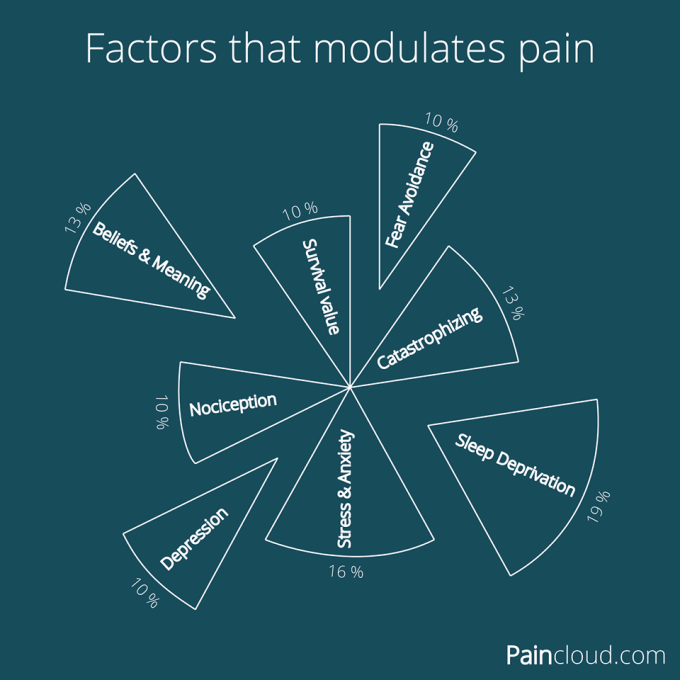
PainCloud Pizza
The above is from PainCloud. A great tool in discussing the multiple aspects that affect a person's sensation.
PainOstat
The above is from PainCloud. Great for explaining about sensitivity. 
Effect-of-isometrics
The above is from http://bjsm.bmj.com/content/early/2015/05/15/bjsports-2014-094386.abstract on patellar tendinopathy. (helpful in getting people to buy in to "just squeezing muscles?!")
Neuromatrix-Simplified
I don't know where the above is from. I first saw it on Matthew Danziger's blog A Primer On Pain in 2013. (Yes, it's not me, we have a similar name... really crazy.) Moving past that doppelganger name bit, here is a link to the content: http://www.ncbi.nlm.nih.gov/pubmed/12909433
Road to recovery
The above is from Adam Meakins. Good to add a little humor in to the process. Also, you physicists will notice: this recovery plan involves time travel, which is exciting.
Road to recovery 2
The above is from Dr. Rod Henderson and Adam Meakins.
Exercise muscle
The above is from https://physsportsmed.org/doi/10.3810/psm.2011.09.1933 or here. This picture is rather motivating, can bust some myths about age and inspire chronic exercise.
Spencer also adds a Pain Video Handout to patients that it is appropriate for. This is good for "Video Homework" and is a great way to share ideas. Good opportunity to ask questions of the patient on the return visit about the content.
Here is what he shares:
Pain Education Videos
  • Go to www.youtube.com
  • Four video’s to watch (by title):
  • “Understanding Pain in less than five minutes.”
    • Time-lapse illustration video explaining pain and our current understanding of it, without technical jargon. (see it here)
  • “Placebo: Cracking the code.”
    • Just watch the first segment (~8 mins long), discusses some “sham” or placebo research done with knee arthroscopic surgeries for knee pain. (see it here)
  • “This Video Will Hurt”
    • Another animated, slightly humorous video discussing research surrounding the opposite of the placebo, the nocebo. (see it here)
  • “Why things Hurt”
    • Australian pain science researcher and physiotherapist, Lorimer Moseley, explains how pain is a construct of the brain. (see it here)
I hope this was helpful. Get out there and engage that population!
An image is a powerful thing. Use the power for good.
-Matt Dancigers, DPT


Interested in live cases where I apply this approach and integrate it with pain science, manual therapy, repeated motions, IASTM, with emphasis on patient education? Check out Modern Manual Therapy!

Keeping it Eclectic...


Pain is like the wind.
It can only be viewed by its interface with the environment. 
We see the trees move, the leaves rustle, the flower petals quiver. We see the thick dust in the air, the yard furniture toppling in a pile by the fence, the branches dropping to the street.  
Our skin turns alive with an unseen pressure. We are urged to move to the left by an unseen force from the right. It blew my hat off.
"I cannot take a picture of the wind. I can show you a picture of a windy day... but not the wind."
It comes up in evaluations and interactions often. "The right knee has the tear in it, but the left one hurts more." or "The MRI showed nothing." I have a canned response since it comes up so much. "Well, you make an excellent point. Thank you for  bringing that up. Now, since pain is a feeling, and not a thing, it does not show up on X-ray/MRI/CT. I cannot hand you some pain (reaching both of my cupped hands forward). There has never been a picture of feeling. There have been pictures of people wincing, or holding a body part, but since pain is a feeling, it will never show up on a picture."
I say this, generally the same way, while gauging understanding as best I can. This may be a good starting place, depending on the patient. Perhaps it's a good analogy to challenge a "seeing is believing" mindset. The wind is no less real.
Pain is like the wind
Pain Wind Scale: "On a scale of 3 to 120 mph, how gusty is your pain today?" *image credit*

Now, the wind analogy is useful to look at the spectrum of what pain is in someone's life. It can blow your neighbors leaves into your yard. It can cool you down on a hot day. Pain serves a biological purpose as a threat/danger signal, but can also be a destructive force. 
Not all the important things in life are made visible.
-Matt Dancigers, DPT
Header image credit 

*Yes there are biological structural processes to pain. Yes there is wind energy physics. 


Interested in live cases where I apply this approach and integrate it with pain science, manual therapy, repeated motions, IASTM, with emphasis on patient education? Check out Modern Manual Therapy!

Keeping it Eclectic...


The decision to go to residency is so easy. Yes, of course I want to go. Learn more? Become better skilled in the path you wish to take? Have confidence in my Knowledge, Skills and Abilities? No problem.
Well, the time and monetary cost (with no direct compensation link) are a common deterrent to pursuing residency after school... or in the middle of a career. Yes, the third year of DPT school should be a residency in your anticipated specialty field, getting paid and paying for a residency... but that's another discussion. For those of you that do not or cannot seek out the residency may I suggest a Self-Residency.

There is a clash between knowing that biomechanics and structure are not 100% responsible (ie. a 1-to-1 relationship) for pain, and the fact that (from an Example I got from Mike Eisenhart) some one with a poorly moving C5-C6, (as best we can tell the difference and as valid as our hands may be) has a risk factor for future neck pains and problems. 
No. Not causative, but a risk factor. 
We run the risk of "throwing the baby out with the bathwater" as it were. Because we know that poor posture does not cause pain, does not mean that a lifestyle, in which poor posture exists and is showing up to you in the clinic, is not a risk factor. These risk factors should be, and need to be addressed.
I really dislike the concept of looking at someone's asymmetries, or different structure and giving them a diagnosis of pathology. It doesn't fit in my perception of reality, and therefore I am very at risk to overlook, ex: not care, about some slight "movement dysfunction." This sets me up to not be as helpful as I could be.
Again, spurred from a convo with Mike E: Are we confusing creating patient independence (and giving them a positive outlook on their condition) with functional return. "Sometimes I think we say, hey, you're functional, that's good enough, insurance won't pay for much more, see ya later."-Mike Eisenhart (@mikeeisenhart). This attitude does not let us help people be "the best they can be, the best version of themselves." Heck, you work on bettering yourself and you are functional!
Maybe insurance won't pay, and yes, Payers are the Fourth Pillar of EBP, but that does not mean we have to stop. We explain that we can help. We have the skills to make life-long change in someone's life... if we simply don't stop at functional.
I struggle with this aspect: the part of DCing someone when they are "good enough." I confuse good enough with functional and done with what physical therapy can offer.
That's a tough concept. When to stop. Especially when the patient could use much more. As Dr. Mark Reid, MD (@medicalaxioms) stated "a correct diagnosis is often not what's wrong with the patient." We can help in many other ways.
Mike Riley, PT (@mikerjrpts) has a great example as well. He spoke of this on Jerry Durham's podcast and at Graham Sessions this year. Here's the gist of it: "if someone comes in with LBP and has CAD risk factors and we only treat the LBP, we are missing our some value. We could educate, teach, instruct, coach and can make a difference. Heck, due to these factors, he could have shoveled snow, had an MI and died vs seeing you for LBP from that same shoveling. We DO have the ability to modify these factors." Exercise. Simple diet instruction. Lifestyle choices. Behavior behavior behavior... over time.
*Is this a perspective shift for you? Does this fit into what you think a PT does?*
There is a difference between a PT clinic with a gym in it, and a gym with a PT in it. One is on one side of the injury, and one is on the other. I love the shift of adding Wellness/Fitness to PT... but a more proactive approach is certainly to add PT to Wellness/Fitness centers. Perhaps this is semantics, but I believe this subtle shift is paramount to impacting communities and perhaps reaching the vague yet ambitious Vision Statement of the APTA. You can't change society from a reactive stance. Yes many come to PT, find joy in the process and develop healthy lifestyle habits to take with them in to the future. But that is only what... 5% of the population. Now maybe only 10% are in gyms/fitness centers... but combines that's 15% and that's a three fold impact YOU could make.
Yes this throws out old ideas. Yes new models of preventative care are babies and need nursing and cuddling to grow. And yes, your current PT practice that sees post-op and reactive care will still exist. There will always be the sick. But a trend towards improving the front end may make those we see a "different kind of sick." Perhaps ones with less co-morbidities.
Let's start with what we can do. Get out there in front of the problem. Put aside the understanding (the truth) that we cannot predict injury 100%, that we cannot prevent injury 100%. We can still modify risk factors. I can say exercise will help. I cannot say exercise will cure. So... I will say exercise will help then. Sorry, changing posture and moving "better" is important. It's important to bend and move into all the corners of your ability and explore the body you live in.
Dr. Spencer Muro (@spencermuro) speaks about how we treat people in this way: he mentions that we, meaning we humans, do not treat anything. We only maximize or leverage the natural healing power of the human body. SSRIs? We are just using the receptors that we have. Hypoalgesia? Sure, we are just "pushing the buttons" to make those hormones drop.. like from a Tabata KB swing set. Since we know that all we do is use the body (like Wolverine) to heal itself... then why can't we wrap our heads around building the body up to reduce the risk of injury/break down/disease? Come on! It's the same process and we are the experts in maximizing what the body comes equipped with! Seriously.
This is our wheelhouse. We swing from here and we blast home-runs for dayyzz.
If a switch to hit this problem from the front end can be made, the back end will be even easier.
-Matt Dancigers, DPT


Interested in live cases where I apply this approach and integrate it with pain science, manual therapy, repeated motions, IASTM, with emphasis on patient education? Check out Modern Manual Therapy!

Keeping it Eclectic...


My clinic serves a low socioeconomic city area. Now, I am sure that there are any number of stranger work conditions, treating in a gang-controlled area, for example, but the conditions and problems of low socioeconomic status (SES) are a niche unto themselves.
Almost everything "straight ortho PT" gets thrown out. Low SES throws a wrench in the gears.
What you perceive today as a struggle is not truly due to the task at hand. It has to do with what the goals of the activity are.
The goal determines how the steps will play out. A worthy goal can bring you through any tough time. If the outcome is not of interest to you, no simple/light task is easy. It's all a struggle if the goal is not meaningful.
 We associate many things with money. One example: If it costs more, it's better.
Money is not just a physical item representative of some good or service.  It has meaning past trade. Having more money does not just mean that you can accumulate more things. Socially, it states that maybe you have accomplished more, are a better decision maker, make better behavior choices, etc. It possesses status and other cultural attributions. Not a surprise. You know this.
The $15 beer will taste superior to the $1.50 beer. It just does, because we know it's better. It's contextual priming. That's why blinded taste trials are often so interesting, because the context is removed and you are left with a singular sensory organ (taste organs of the tongue and mouth, yes and olfaction).