Modern Manual Therapy Blog - Manual Therapy, Videos, Neurodynamics, Podcasts, Research Reviews: #cervicogenic dizziness #manualtherapy #clinicalreasoning #cervicalspine #dizziness
Showing posts with label #cervicogenic dizziness #manualtherapy #clinicalreasoning #cervicalspine #dizziness. Show all posts

In the field of Orthopaedic Manual Therapy, one of the first things we learn are contraindications (relative and absolute) and precautions prior to performing a procedure.  A full list of cautionary measures is beyond this blog post, but one I want to bring to attention is recent infection (particularly throat injection).
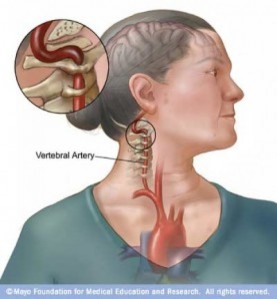
In conventional clinical reasoning, a recent infection is associated with a risk factor (recent event) for cervical instability but substantially more dangerous of a condition, with fatal consequences, is the arrival of a spontaneous cervical artery dissection.  Frankly speaking, this could be the start of a stroke in process and is an absolute contraindication to physical therapy (or even chiropractic, massage, osteopathic, etc) treatment; but requires medical intervention.
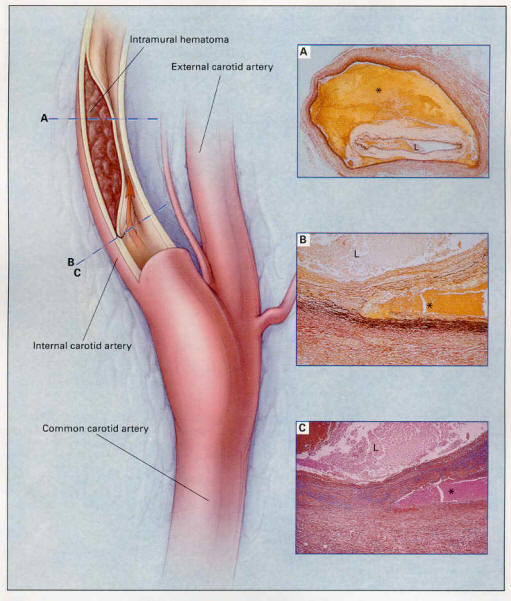
We do know there are some risk factors, including trivial trauma (minor and major) and symptomology associated with increased suspicion of a spontaneous cervical artery dissection in process.  One risk factor that continues to arise in the literature but not as confirmatory of a dissection prospect, at least compared to other factors of vascular turbulence, is connective tissue disorders.
I want to send the readers over to a recent article by James Demetrious in the Chiropractic & Manual Therapies Journal (2018).  He examines the thought & reasoning process that Fluoroquinolone antibiotics constitute a risk factor for cervical artery dissections.  I recommend reading the article (it’s short AND free) for full details but I want to highlight a quote from the article:
It is plausible that fluoroquinolones may incite connective tissue degradation and play a contributory role in the genesis of cervical artery dissections…..A causal relationship of fluoroquinolone antibiotics to cervical artery dissection is plausible. Fluoroquinolones may indeed be a novel and previously unrecognized cause of cervical artery dissections.
So you may ask, what is the relationship with recent infection??
—>the patient will of course go to a medical physician for potential infection
—>>potentially be prescribed this class of medication (which can cause degradation of connective tissues)
–>> then may or may not have trivial trauma and seek out your consultation and treatment for headache, dizziness, neck pain, etc.
There is definitely more research needed on this topic but I found this to be an intriguing article and confirms more precaution should go through a clinician’s mind and reasoning process when a patient has recently had an infection.
In our Cervicogenic Dizziness Course, we go over our Optimal Sequence Algorithm on the first day; which gives you the best of the best in the literature associating risk factors, symptomology & clinical examination procedures to make sure you are confident that the patient in front of you has a mechanical disorder.  We find it is a must when dealing with the intimidating field of dizziness, especially if you aim to address the upper cervical spine.

You can learn more about the screening and treatment process of Cervicogenic Dizzinesss through Integrative Clinical Concepts, where the authors (husband–a manual therapist a wife—a vestibular specialist), teach a very unique course combining both the theory and practice of vestibular and manual principles in their 2-day course.  Pertinent to this blog post, the 2nd day includes the “Physio Blend”, a multi-faceted physiotherapist approach to the management of Cervicogenic Dizziness, which includes treatments of the articular and non-articular system of manual therapy and the most updated sensorimotor exercise regimen.
If you would like to host a course for your staff (either a vestibular, neuro, sports or ortho clinic), please do not hesitate to contact me at harrisonvaughanpt@gmail.com for more information.

Authors

Harrison N. Vaughan, PT, DPT, OCS, Dip. Osteopracic, FAAOMPT    
Instructor: Cervicogenic Dizziness for Integrative Clinical Concepts
Danielle N. Vaughan, PT, DPT, Vestibular Specialist  
Instructor: Cervicogenic Dizziness for Integrative Clinical Concepts

Want to learn in person? Attend a #manualtherapyparty! Check out our course calendar below!

Learn more online!


Want an approach that enhances your existing evaluation and treatment? No commercial model gives you THE answer. You need an approach that blends the modern with the old school. Live cases, webinars, lectures, Q&A, hundreds of techniques and more! Check out Modern Manual Therapy!

Keeping it Eclectic...


The Dix-Hallpike Manuever is considered the gold standard for the diagnosis of posterior semicircular canal Benign Paroxysmal Positional Vertigo (BPPV).  It has decent statistics in its utility in just itself having a sensitivity of 79%, specificity of 75%, LR+ = 3.17 and LR- = 0.28  (Haulker et al 2008) and lends itself very convenient for smooth transition into treatment via the Epley Manuever.


Historically speaking, most practitioners in medicine attribute cervical artery dissection (potentially lead to stroke) to manipulation of the cervical spine–especially from the chiropractic profession.  Several come to my mind including Grant 1987/88, Drueger & Okazaki 1980, Terrett 1987, Hurwitz 1996. This was echoed through the years from emergency medicine physicians in case reports, case series and case control studies but in the last decade, our knowledge on this phenomenon has changed our perspective of the cause.

We now know from the works of many authors, but especially the case-crossover design work of Cassidy in 2008 and reflected again in 2017; that most likely a patient is arriving to your clinic with a stroke in progress.  Briefly speaking, the practitioner must have felt the symptoms were musculoskeletal in nature, but instead, were of vascular nocioception and the headache/dizziness/etc was the symptom that led the individual to seek out help.  Basically, a potentially fatal condition was missed.  For us in the industry who keep up with this data, the trend is leaning towards a more global screening processes including the vascular system to make a more informed decision with positive results, but there are many cases that are still reported, including recently in a Family Practice Journal.
I recently stumbled upon two papers indicating a spontaneous dissection that led a patient to a healthcare provider—in these cases the treatment approach was not manipulation, but cupping and massage.
I can provide full texts to those who wish to read, but here is synopsis:
Choi et al 2016
We report an extremely rare case of spontaneous extracranial VA dissection presenting with posterior neck hematoma aggravated after cupping therapy.
“We presume that when spontaneous extracranial VAD occurred, his neck pain began and the cupping therapy caused a VA rupture and posterior neck hematoma with a pseudoaneurysm.”
Dutta et al 2018
We present an unusual case of vertebral artery dissection in a 30-year-old male patient following an episode of neck massage….The current case demonstrates the hazards associated with neck massage and the potential for good outcomes in these patients if timely intervention is provided.
For those of you who treat headaches, neck pain and dizziness; albeit very rare, you should always keep in mind potential cervical artery dysfunction.  It could arise spontaneously or after a trauma, even trivial.  Although we are still working in a diagnosis and area of uncertainty, I would suggest these two reports correlate with our trend that the actual procedure doesn’t cause the stroke—but instead, the acute arterial event was occurring spontaneously which led to a patient coming to you for help.
In the Optimal Sequence Algorithm of our Cervicogenic Dizziness Course, this is a hot topic and one that I take very seriously.  Alongside my fellowship mentor, Dr. Brent Harper, we have designed what we both find to be the most up-to-date and sound reasoning to rule out spontaneous and mechanical vascular event.  We strive to improve the order of your examination definitely makes a difference — which is one of the major flaws behind the vertebral-basilar insufficiency (VBI) test.
Even though I find our approach is quite sound, I want to end this post with the conclusion from Choi et al 2016 as it is a solid statement and a major take-home point:
The clinical diagnosis of VAD is not easy with acute-onset neck pain, especially young patients with no evidence of cervical trauma and disease. With undiagnosed VAD, traditional remedies such as cupping and chiropractic therapy to reduce pain can aggravate spontaneous dissection and worsen symptoms…..Early diagnosis of VAD could prevent symptom aggravation and permanent neurologic deficit.

You can learn more about the screening and treatment process of Cervicogenic Dizzinesss through Integrative Clinical Concepts, where the author and his wife, a Vestibular Specialist, teach a 2-day course.  Pertinent to this blog post, the first day provides the most up-to-date evidence review from multiple disciplines to diagnose through the “Optimal Sequence Algorithm” to assist in ruling out disorders and ruling in cervical spine, including determining if single or double entity exists.  
If you would like to host a course for your staff (either a vestibular, neuro, sports or ortho clinic), please do not hesitate to contact me at harrisonvaughanpt@gmail.com for prices and discounts.
Authors
Harrison N. Vaughan, PT, DPT, OCS, Dip. Osteopracic, FAAOMPT    
Instructor: Cervicogenic Dizziness for Integrative Clinical Concepts
Danielle N. Vaughan, PT, DPT, Vestibular Specialist  
Instructor: Cervicogenic Dizziness for Integrative Clinical Concepts

Keeping it Eclectic...

When considering dizziness of cervical origin, it is well accepted in clinical practice to follow the rule of “diagnosis of exclusion”.  This means that you can suspect, but not confirm, dizziness or vertigo from the neck unless you rule out other competing diagnoses.
It is thrown around from ones who try to invalidate the condition that up to 90% of cases can have a convincing alternative diagnosis.  Additionally, Cervicogenic Dizziness can affect populations across the lifespan with traumatic and even non-traumatic origin. Therefore, the prevalence of Cervicogenic Dizziness can be challenging to truly calculate.
However, we can reach out to the literature to provide some input on how frequent patients have Cervicogenic Dizziness.  We provide a synopsis for you below to help with prevalence rates for these subcategories.

Elderly / Geriatrics

A classic study cited in most often comes from Colledge et al in 1996 in BMJ.  This is a community based study looking at causes of dizziness in elderly patients in primary care practice.  The investigators found that 30% of total patients had dizziness symptoms and contributed 66% of those cases to cervical spondylosis (arthritis).  Two-thirds of the patients with dizziness coming from the neck is a significant proportion!
A more recent study by Sho Takahashi in 2018 retrospectively examined the cause of general dizziness in an outpatient setting.  Out of the 1000 patients, 899 (90%) were found to have cervicogenic general dizziness.  The authors contribute cervical spinal canal stenosis as the culprit in the group with average age of 62 years old.  Wow, 9 out of 10 patients were found to have dizziness coming from the neck!
So yes, the geriatric population, even though with higher proportion of competing diagnoses including peripheral, cardiovascular, and psychological causes; have a high prevalence of Cervicogenic Dizziness.  For therapists out there who are in vestibular rehab / neuro rehab and even home health, this is something to consider!
We can’t forget the data from the concussion and whiplash literature.  Here are some other robust numbers for you:

Whiplash

The literature on this is somewhat older but still very pertinent, stands true to today, and actually we have more data from multiple sources.  I always say about half of patients who have had whiplash-associated disorder experience dizziness and/or imbalance. To name a few, I recommend reading the works of Diane Wrisley 2000Oostesteveld et al 1991Skovron 1998Humphreys & Peterson 2013. 

Non-Traumatic Cervicogenic Dizziness

For those who are not treating the elderly and not dealing with trauma, the numbers are not nearly as hefty.  I always mention to my students that the prevalence in this realm is ~10%.  Even though the patient age and criteria within these studies vary, I lump this under non-traumatic Cervicogenic Dizziness. This is where I get my data:
Ardic et al 2006, in a retrospective chart review, noted dizziness of cervical origin at 7.5%.
Luscher et al 2014, in a prospective, observational, multi-center study, noted dizziness of cervical origin at 6.4%.
Reid et al 2015, in a randomized-controlled trial, had 8.5% of participants fulfill the inclusion and exclusion criteria as having Cervicogenic Dizziness.
From the outside looking in, the literature is all over the place with our prevalence numbers!  This is what makes the condition challenging and exciting to treat and help others.  You can consider Cervicogenic Dizziness as a single entity, double entity and even traumatic vs non-traumatic origin. Therefore, the prevalence of Cervicogenic Dizziness can be challenging to truly calculate.  I hope this information helps you make a better decision in the office.


You can learn more about the screening and treatment process of Cervicogenic Dizzinesss through Integrative Clinical Concepts, where the authors (husband–a manual therapist a wife—a vestibular specialist), teach a very unique course combining both the theory and practice of vestibular and manual principles in their 2-day course.  Pertinent to this blog post, the 1st day includes the “Optimal Sequence Algorithm”, a multi-faceted physiotherapist approach to the assessment of Cervicogenic Dizziness, which includes the appropriate ruling-out process and cervical examination of the articular and non-articular systems. Also pertinent to this blog post, the 2nd day includes the “Physio Blend”, a multi-faceted physiotherapist approach to the management of Cervicogenic Dizziness, which includes treatments of the articular and non-articular system of manual therapy and the most updated sensorimotor exercise regimen.
If you would like to host a course for your staff (either a vestibular, neuro, sports or ortho clinic), please do not hesitate to contact me at harrisonvaughanpt@gmail.com for more information.

Authors

Harrison N. Vaughan, PT, DPT, OCS, Dip. Osteopracic, FAAOMPT    
Instructor: Cervicogenic Dizziness for Integrative Clinical Concepts
Danielle N. Vaughan, PT, DPT, Vestibular Specialist  
Instructor: Cervicogenic Dizziness for Integrative Clinical Concepts


Want to learn in person? Attend a #manualtherapyparty! Check out our course calendar below!

Learn more online!


Want an approach that enhances your existing evaluation and treatment? No commercial model gives you THE answer. You need an approach that blends the modern with the old school. Live cases, webinars, lectures, Q&A, hundreds of techniques and more! Check out Modern Manual Therapy!

Keeping it Eclectic...


Concussion has been a hot topic in the last few years and continues to grow in awareness, diagnostic and treatment options in the field of medicine.  Rehabilitation professionals, such as physical therapists, play a vital role in recovery from this injury and can be argued to be the best healthcare provider to aid in a progressive, graded exposure to return to sport/play.  Treating patients recovering from this injury can be challenging but our field offers us the training and ability to address the multiple dimensions of symptoms; including the oculomotor, vestibular, cervical and central impairments.
Even though concussion can be considered physiologically a “brain injury”, there is a plethora of data correlating the mechanism of injury and impulsive forces to whiplash mechanism, such as seen in a car wreck (Elkin et al 2016Alexander 2003Hynes & Dickey 2006, Morin 2016).  So not only could impulsive forces in concussion involve the head, but the neck as well (Marshall 2015Kennedy 2017).  This is not a new subject per say, but with the continued expression of “brain injury” and “central condition”; I want to express to my colleagues that symptoms of headache and dizziness could be generators of nocioception and/or alterered proprioception.  There have been some authors to go as far as suggesting concussion should be appropriately called the monikor craniocervical shaky syndrome (CCSS).
Instead of simply allowing the brain injury diagnosis sticker dampen the prognosis to allow healing to occur, it is recommended to consider the cervical spine a potential reason/cause for post-concussion persistent symptoms.  Considering dizziness after sport-related concussion is common and reported to be in 43-81% of cases (Alslaheen et al 2010Duhaime et al 2012Lau et al 2011), it is highly recommended to get the formal assessment, evidence and treatment for these patients.
Cervicogenic Dizziness Course - Integrative Clinical Concepts
Let’s move on together to aid in finding potential, pragmatic and VERY treatable region of the body.  It can be challenging to find which system is of particular importance in the driver of post-concussive symptoms, but if you think it is the cervical spine, we have the answers for you.

You can learn more about the screening and treatment process of Cervicogenic Dizzinesss through Integrative Clinical Concepts, where the authors (husband–a manual therapist a wife—a vestibular specialist), teach a very unique course combining both the theory and practice of vestibular and manual principles in their 2-day course.  Pertinent to this blog post, the 1st day includes the “Optimal Sequence Algorithm”, a multi-faceted physiotherapist diagnostic approach of Cervicogenic Dizziness, which includes ruling out central and peripheral disorders to rule in the cervical spine as driver of proprioceptive dysfunction.
If you would like to host a course for your staff (either a vestibular, neuro, sports or ortho clinic), please do not hesitate to contact me at harrisonvaughanpt@gmail.com for more information.

Authors

Harrison N. Vaughan, PT, DPT, OCS, Dip. Osteopracic, FAAOMPT    
Instructor: Cervicogenic Dizziness for Integrative Clinical Concepts
Danielle N. Vaughan, PT, DPT, Vestibular Specialist  
Instructor: Cervicogenic Dizziness for Integrative Clinical Concepts


Want to learn in person? Attend a #manualtherapyparty! Check out our course calendar below!

Learn more online!


Want an approach that enhances your existing evaluation and treatment? No commercial model gives you THE answer. You need an approach that blends the modern with the old school. Live cases, webinars, lectures, Q&A, hundreds of techniques and more! Check out Modern Manual Therapy!

Keeping it Eclectic...

 Cervical Vertigo, Cervicogenic Dizziness, Cervicogenic Dizziness Course


While answering the question, “Is Osteopathic Treatment effective on Cervicogenic Dizziness”, I must preface to say I am not an osteopathic physician and do not practice in that theoretical construct.  However, for those readers who understand the mechanisms of manual therapy and history behind the field of Physical Therapy and Osteopathic medicine; I am sure you can appreciate the correlation of Osteopathic medicine and subset of Manual Therapy within the larger scope of practice in Physical Therapy.  Here is a synopsis if you haven’t delved into the history.  Understanding this correlation will allow the clinician to delve deeper into the literature of other professions in order to have a broader consideration of the effects of manual therapies on individuals suffering from Cervicogenic Dizziness and ultimately give your patients the most comprehensive treatment.
While inquiring PubMed for literature support, unfortunately the terminology of Cervicogenic Dizziness comes up empty.  Why?  Well, read a previous post for that.  Nonetheless, Cervical Vertigo brings me information from Hulse et al in 1975.  As expected, the thought process realms from disturbances of the upper cervical spine and the authors recommend manipulation as treatment of choice.
As the years go by, it is difficult to find literary works specifically for the benefit of Osteopathic treatment for Cervicogenic Dizziness.  However, we do have a some information provided by:
  • A case report by Kennedy in 2002
  • A case report by Shaffer in 2005
  • A case report by Fraix in 2009.
  • A case series by Berkowitz in 2009.
  • A case report by McCallister et al 2016 – of note, this was on a patient with severe TBI
Since these are in the lower levels of evidence, the main chunk of justification doesn’t start until when we delve into Fraix’s work in 2010.  A pilot study, here is Fraix’s conclusion
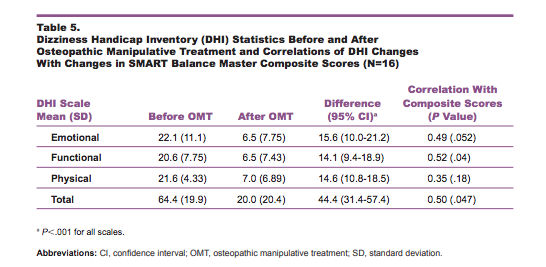
This study showed that OMT is generally well tolerated in patients with vertigo. It also demonstrated that it is feasible to recruit a population of patients with vertigo who can complete a course of OMT and collect data by using the DHI. A randomized control trial that examines the efficacy of OMT in patients with vertigo is warranted, given that OMT may be a reasonable treatment for vertigo and the functional impairment associated with it.
Of course this study has limitations, but I do like how it uses the Dizziness Handicap Inventory (DHI) as a functional outcome measure to show effectiveness of the intervention with a validated and reliable outcome measure.  See results in Figure 1 from the article below:
Fraix 2010
As far as I know, a follow-up RCT designed to compare Osteopathic Treatment to Vestibular Rehabilitation never made it to publication.  However, we do have some other evidence of the effects of osteopathic treatment in the last few years.
In 2013, Fraix and colleagues in a prospective clinical cohort study evaluated the effect of osteopathic manipulative treatment (OMT) for spinal somatic dysfunction in patients with dizziness lasting longer than 3 months.  Here is their conclusion:
Osteopathic manipulative treatment for spinal somatic dysfunction improved balance in patients with dizziness lasting at least 3 months.
Fraix 2013
In 2017, Papa and colleagues in a randomized control trial examined a group of 31 individuals with BPPV and again used DHI as outcome measure.  Here is their conclusion:
These findings suggest that OMT could be a useful approach to reduce imbalance symptoms and to improve the quality of life in patients suffering from dizziness
Papa 2017
In conclusion, the evidence is slowly, but starting to mount to give more credence to Osteopathic Treatment for Cervicogenic Dizziness.  I do not hesitantly justify this as simply another means of evidence denoting the benefit of manual therapy, which can be provided by trained physical therapists, for the treatment of Cervicogenic Dizziness / Cervical Vertigo.
The justification for our services and approaches are continuing to mount, for the sake of the patient, our referral sources, for us personally and for the 3rd party payers.  Anyone who has taken my courses knows evidence is a top priority and you will get the information you need to not only learn how to diagnose and treat Cervicogenic Dizziness, but the paper trail that puts more substance into our practice.

You can learn more about the screening and treatment process of Cervicogenic Dizzinesss through Integrative Clinical Concepts, where the authors (husband–a manual therapist a wife—a vestibular specialist), teach a very unique course combining both the theory and practice of vestibular and manual principles in their 2-day course.  Pertinent to this blog post, the 2nd day includes the “Physio Blend”, a multi-faceted physiotherapist approach to the management of Cervicogenic Dizziness, which includes treatments of the articular and non-articular system of manual therapy and the most updated sensorimotor exercise regimen.
If you would like to host a course for your staff (either a vestibular, neuro, sports or ortho clinic), please do not hesitate to contact me at harrisonvaughanpt@gmail.com for more information.

Authors

Harrison N. Vaughan, PT, DPT, OCS, Dip. Osteopracic, FAAOMPT    
Instructor: Cervicogenic Dizziness for Integrative Clinical Concepts
Danielle N. Vaughan, PT, DPT, Vestibular Specialist  
Instructor: Cervicogenic Dizziness for Integrative Clinical Concepts


Want to learn in person? Attend a #manualtherapyparty! Check out our course calendar below!

Learn more online!


Want an approach that enhances your existing evaluation and treatment? No commercial model gives you THE answer. You need an approach that blends the modern with the old school. Live cases, webinars, lectures, Q&A, hundreds of techniques and more! Check out Modern Manual Therapy!

Keeping it Eclectic...
The title of this blog is a loaded question, but generally speaking it entails the risk : benefit ratio and adverse events of performing manual therapy on a patient who has suffered a concussion.  In particular, we are speaking of someone who is suffering from post-concussive symptoms after mild traumatic brain injury (mTBI).  In this post, we will use mTBI synonymously with post-concussion symptoms. This patient is already in your office, you have determined some type of musculoskeletal generator for symptoms, most likely neck pain, dizziness and/or headache; so you proceed with what you have in your tool box.
Cervical spine involvement in mTBI is gaining more traction over the years. There have been countless case reports and case studies on the benefit of manual therapy for mTBI (to name a few–Gurnseley 2016Burns 2015Weltzer 2017).  In fact, Brolinson recommends using manual therapies alongside neuromotor/sensorimotor training for more effective  mTBI recovery than rest and exercises.  Also, we can’t forget the all important Schneider study from 2014 that found a significant number of athletes returned to sport in manual / vestibular group compared to control group.
Most recently, Quatman-Yates in 2016 found the following conclusion:
The results of this systematic review indicate that several physical rehabilitation options with minimal risk for negative outcomes are available for treating patients experiencing persistent post-mTBI symptoms. These options include: vestibular, manual, and progressive exercise interventions.
In general, the literature does guide us that manual therapies can be a safe and effective intervention to the cervical spine for mTBI.  In fact, if you break down adverse events in Cervicogenic Dizziness / Cervical Vertigo, you will not find the literature shying away from manual therapy either.  Even though no study has been conducted directly examining adverse events, it can be noted that the largest randomized control trial and long term outcomes to date by Reid and colleagues specifically state no adverse events in the group of eighty-six participants receiving manual therapy.
However, there is one study I want to bring to light.  It is from Dr. Greenman and his colleague, Dr. McPartland back in 1995 entitled, “Cranial findings and iatrogenesis from craniosacral manipulation in patients with traumatic brain injury“.  For those who do not know, Greenman was well known at Michigan State in Osteopathic Medicine and well cited in books and journals.  Even though the practice and treatment of craniosacral manipulation is beyond this blog and post, it is worth noting the findings of this brief review below:
Out of 55 cases, the authors describe 3 cases of adverse events of craniosacral therapy in patients with mTBI, including 2 requiring hospitalization.  They noted a 5% incidence rate and quoted the following, “craniosacral manipulation in a traumatic brain-injured patient can be useful and effective, but is not without risk”.
This number may not mean much to you—but we all hope as clinicians it is 0%—but it all depending on how you define iatrogenesis.  Nevertheless, I suggest you compare this number to Carnes’ 2010 study noting incidence estimate of proportions for minor or moderate transient adverse events after manual therapy was approximately 41% (CI 95% 17-68%) in the cohort studies and 22% (CI 95% 11.1-36.2%) in the RCTs; for major adverse events approximately 0.13%.
However, Sabel and Patini in 2018 in a pilot study examined safety of Osteopathic Manipulative Medicine in PostConcussion Symptom Management and elicited the following conclusion:
Osteopathic cranial manipulative medicine was considered a safe adjunctive treatment option to improve concussion-related symptoms and recovery.
In conclusion, I say there are minor adverse events to any intervention but we definitely want to have a treatment approach that minimizes risk while add benefit.  The type of technique, approach and handling skills can all be combined to making this formula turn out best for you and the patient.  In our Cervicogenic Dizziness Course, we teach a variety of techniques that add on what you already know and propel it towards maximal comfort and relief.  Come check us out near you.

You can learn more about the screening and treatment process of Cervicogenic Dizzinesss through Integrative Clinical Concepts, where the authors (husband–a manual therapist a wife—a vestibular specialist), teach a very unique course combining both the theory and practice of vestibular and manual principles in their 2-day course.  Pertinent to this blog post, the 2nd day includes the “Physio Blend”, a multi-faceted physiotherapist approach to the management of Cervicogenic Dizziness, which includes treatments of the articular and non-articular system of manual therapy and the most updated sensorimotor exercise regimen.
If you would like to host a course for your staff (either a vestibular, neuro, sports or ortho clinic), please do not hesitate to contact me at harrisonvaughanpt@gmail.com for more information.

Authors

Harrison N. Vaughan, PT, DPT, OCS, Dip. Osteopracic, FAAOMPT    
Instructor: Cervicogenic Dizziness for Integrative Clinical Concepts
Danielle N. Vaughan, PT, DPT, Vestibular Specialist  
Instructor: Cervicogenic Dizziness for Integrative Clinical Concepts

Want to learn in person? Attend a #manualtherapyparty! Check out our course calendar below!

Learn more online!


Want an approach that enhances your existing evaluation and treatment? No commercial model gives you THE answer. You need an approach that blends the modern with the old school. Live cases, webinars, lectures, Q&A, hundreds of techniques and more! Check out Modern Manual Therapy!

Keeping it Eclectic...